


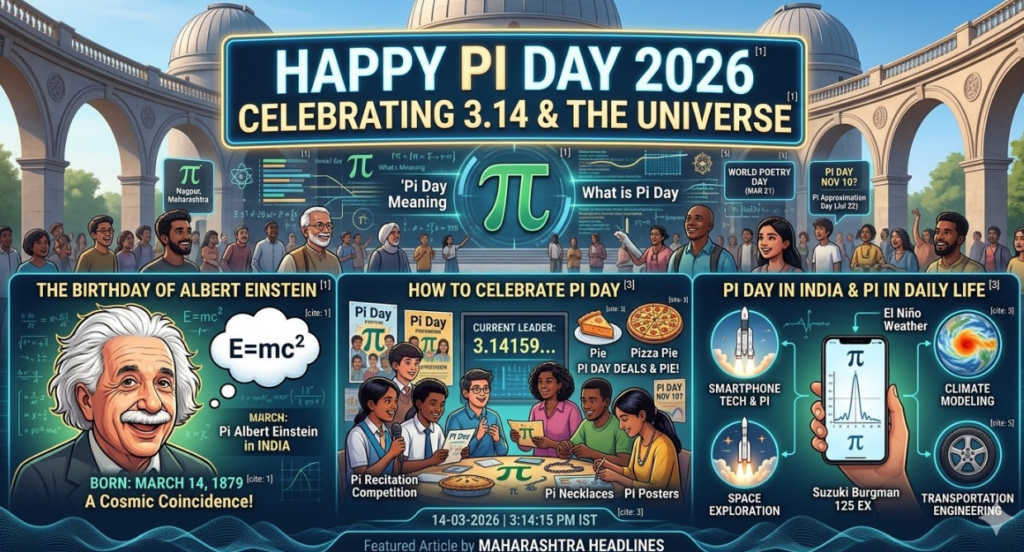
To truly appreciate circle geometry, one must understand the significance of pi, a fundamental mathematical constant If there is one day of the year when mathematicians, students, bakers, and science enthusiasts all come together to celebrate, it is March 14th. Yes, we are talking about Pi Day! As we gear up for Pi Day 2026, there is a lot of excitement in the air. Whether you are a math whiz who can recite hundred digits of this magical number, or someone who just really loves eating pie, this day has something special for everyone.
In this comprehensive guide, we will explore the Pi Day meaning, dive into its fascinating history, look at how it is celebrated in India and around the world, and even uncover some incredible connections between this mathematical constant and the universe we live in. We will use simple language to keep things fun and engaging. So, let’s slice into the wonderful world of Pi!
What is Pi and What is the Pi Number?
Before we talk about the celebrations, we need to answer a fundamental question: what is pi?
In simple terms, Pi is a mathematical constant. If you take any circle in the universe—whether it is a tiny coin or the equator of a massive planet—and divide its circumference (the distance around the edge) by its diameter (the distance straight across the middle), you will always get the exact same number. That number is Pi.
The pi value is approximately 3.14159. However, Pi is what mathematicians call an “irrational number.” This means that its decimal representation never ends and never settles into a permanently repeating pattern. It goes on for infinity! When we write equations, we use the Greek letter $\pi$ to represent it.
Because the first three digits of the pi number are 3, 1, and 4, the date March 14th (written as 3/14 in the American date format) is the perfect day to celebrate it.
The History of Pi : When Was Pi Day First Celebrated?
You might be wondering, when was pi day first celebrated? The holiday was actually born out of a desire to make math fun and accessible to the public.
The first large-scale official celebration took place in 1988 at the San Francisco Exploratorium. A physicist named Larry Shaw organized the event. He and his colleagues marched around a circular space at the museum and then ate fruit pies. The idea was incredibly catchy, and the tradition quickly spread.
But why pi day is celebrated worldwide today? In 2009, the United States House of Representatives passed a non-binding resolution recognizing March 14 as National Pi Day. The goal was to encourage schools and educators to teach students about math and science in an engaging way. Today, saying “happy pi day” on March 14th is a global phenomenon.
Who Invented Pi and Who Discovered Pi?
It is important to note that no single person “invented” Pi, because it is a fundamental truth of geometry. It existed in the universe long before humans were here to calculate it. However, when we ask who discovered pi, we look back at ancient civilizations.
The ancient Babylonians and Egyptians first calculated rough approximations of Pi around 4,000 years ago. Later, the brilliant Greek mathematician Archimedes of Syracuse (around 250 BC) created an algorithm to calculate it much more precisely.
Centuries later, the symbol $\pi$ was first introduced by Welsh mathematician William Jones in 1706, and it was popularized by the legendary Swiss mathematician Leonhard Euler in 1737.
The Ultimate Birthday Coincidence
One of the most amazing facts about this day is the answer to the popular trivia question: pi day is celebrated on whose birthday? It just so happens that March 14th is the Albert Einstein birthday! Born on March 14, 1879, Albert Einstein went on to revolutionize physics with his theory of relativity. The fact that the most famous scientist in modern history was born on a day dedicated to the most famous mathematical constant is a beautiful cosmic coincidence.
Celebrating a pi day birthday is a badge of honor for anyone born on March 14. Schools often celebrate Einstein’s life alongside Pi Day activities, making it a dual celebration of math and physics.
Pi Day in India: Celebrations and Meanings
The love for mathematics runs deep in Indian culture. Historically, great Indian mathematicians like Aryabhata made incredibly accurate calculations of the pi value way back in the 5th century.
So, when is pi day celebrated in India? Just like the rest of the world, it is celebrated on March 14th.
When was pi day first celebrated in India? While Indian mathematicians have revered the concept of Pi for centuries, the specific pop-culture celebration of “Pi Day” on March 14th began to gain serious traction in the early 2000s, driven by the rise of the internet, globalized education systems, and social media.
If you are looking for the pi day meaning in hindi, it is generally referred to as पाई दिवस (Pi Diwas). Educational institutions like the IITs, IISc, and various local schools across the country hold math quizzes, memory competitions (seeing who can recite the most decimal places of Pi), and poster-making contests.
Important Dates and How Pi Is Used in Daily Life
While March 14 is the main event, the math community loves to find other dates to celebrate.
- Pi Approximation Day: Celebrated on July 22nd (written as 22/7 in the day/month format). Since the fraction 22/7 is a common approximation of Pi used in schools, July 22 is known as pi approximation day.
- Pi Day November: Some math enthusiasts celebrate pi day november on November 10th (or Nov 9th in leap years), because it is the 314th day of the year!
- National Pie Day vs Pi Day: People often confuse these two! While Pi Day (math) is March 14, National Pie Day (the baked dessert) is celebrated earlier in the year, on January 23rd, established by the American Pie Council. However, bakers happily celebrate both!
- Global Translations: If you want to impress your friends and translate pi day from vietnamese, it is called Ngày số Pi.
A Look Back at Epic Pi Days
Every year brings a new flavor to Pi Day. Let’s look at some notable years:
- Pi Day 2015: This was the “Super Pi Day” or the “Pi Day of the Century.” The date was 3/14/15. At exactly 9:26:53 AM, the date and time perfectly matched the first 10 digits of Pi: 3.141592653. Math geeks around the world threw massive parties.
- Pi Day 2024: After the pandemic years, pi day 2024 saw a massive return to in-person school events and large-scale bakery discounts.
- Pi Day 2025: Celebrated just last year, pi day 2025 focused heavily on AI and how computers calculate Pi to trillions of digits.
- Pi Day 2026: Now we look forward to pi day 2026. The expected pi day 2026 theme in many educational circles is “Mathematics in Nature,” exploring how the golden ratio and Pi appear naturally in the world.
How to Celebrate Pi Day 2026
If you want to get involved this year, here are some fantastic ways to celebrate:
1. Score Some Pi Day Deals
Restaurants and bakeries love to get in on the action. Keep an eye out for pi day deals and specific pi day 2026 deals. Many pizza chains will offer a whole pizza pie for just $3.14, or offer $3.14 off large orders. Bakeries also discount fruit pies and sweet treats.
2. Pi Day for Kids
Making math fun is the whole point! A great pi day celebration idea for classrooms is the “Pi Necklace.” Give kids different colored beads, assigning a color to digits 0 through 9. Have them string the beads according to the digits of Pi. It is a fantastic pi day for kids activity.
3. Create a Pi Day Poster
Schools usually host art competitions. Drawing a creative pi day poster that incorporates circles, the $\pi$ symbol, and Albert Einstein’s face is a wonderful way to blend art and mathematics.
The Infinite Reach of Pi: How Math Connects the World
One of the most beautiful things about Pi is that it isn’t just a number on a chalkboard; it is a vital tool used to understand our incredibly complex, real-world environment. Pi is used in engineering, space exploration, climatology, and even everyday consumer technology.
To truly understand how far-reaching math is, let’s look at how the analytical power behind Pi connects to almost everything in our daily news cycle and modern lives.
Space and Astronomy
Whenever the Indian Space Research Organisation (ISRO) launches a satellite and beams back breathtaking india space photos, you can be sure Pi was involved. Calculating orbits, spacecraft trajectories, and the spherical volume of planets requires precise Pi values. Without Pi, modern space exploration simply wouldn’t exist. Furthermore, astrophysicists use Pi to calculate the size and impact zones of celestial threats. For instance, when analyzing historical geological data to study how an ancient asteroid hit north sea tsunami events, scientists rely on circular wave equations where Pi is the star of the show.
Weather and Climate
Meteorologists use Pi in the complex algorithms that model our climate. When scientists predict the chaotic and shifting patterns of el nino weather phenomena, they use thermodynamic equations and fluid dynamics—all of which heavily feature Pi to model the curved flow of wind and ocean currents across the spherical Earth.
Everyday Technology and Lifestyle
Believe it or not, Pi makes your everyday life run smoothly.
- Smartphones: The engineers who design the sleek, rounded edges and the internal signal processing of the latest mobile phones (whether it’s an iPhone or the rumored xiaomi poco x8 pro max) use Fourier transforms, a mathematical operation heavily reliant on Pi, to ensure your phone can connect to cell towers.
- Transportation: Automotive engineers designing the wheels, tires, and cylinders of modern vehicles—like someone picking out the fresh suzuki burgman 125 ex new color at a dealership—rely on Pi to calculate tire rotation speeds and engine capacities.
- Corporate Problem Solving: The analytical, logical mindset required to calculate complex math is the same mindset needed for top-tier business leadership. Whether a student is trying to memorize Pi, or an executive is trying to figure out the julie sweet promotion requirements to climb the corporate ladder at Accenture, success relies on pattern recognition, dedication, and analytical thinking.
Art and Culture
Finally, Pi proves that math and art are not opposites. Just one week after Pi Day, the globe celebrates world poetry day on March 21st. Did you know there is a form of poetry called “Pilish”? In Pilish, the length of each word in a poem must match the digits of Pi. For example, the phrase “How I need a drink” has 3, 1, 4, 1, 5 letters, perfectly matching 3.1415! It is a beautiful intersection of a pi day celebration and poetic creativity.

Conclusion
As we look forward to Pi Day 2026, let’s remember what the day truly represents. It is more than just an excuse to eat pizza and pie (though we highly recommend doing that!). It is a celebration of human curiosity. From the ancient scholars who first asked “what is pi” to the modern scientists using the pi value to send rovers to Mars, Pi represents our eternal quest to understand the universe. For centuries, mathematicians have been fascinated by calculating pi. Methods have evolved from archaic approximations to complex algorithms that can determine trillions of digits of pi, revealing its mysterious non-repeating nature.”
So on March 14th, grab a slice of your favorite pie, share a fun math fact with a friend, and take a moment to wish the world a very Happy Pi Day!