

“Govinda! Govinda!” These two words, roared by thousands of voices in unison, define the atmosphere of one of the most sacred places on Earth. Tucked away in the green Seshachalam Hills of Andhra Pradesh, India, the Tirupati Temple, officially known as the Tirumala Venkateswara Temple, is a powerhouse of Hindu faith.

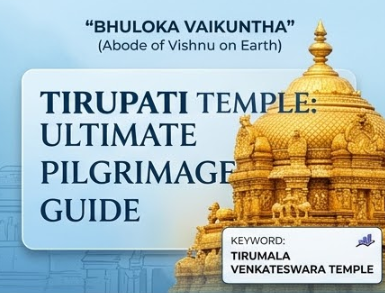
This is not just a building; it is the spiritual ground zero for millions of devotees who travel from across the globe every year. They come seeking blessings, offering their hair, donating their wealth, or simply hoping for a five-second glimpse of their beloved deity, Lord Venkateswara (also affectionately known as Tirupati Balaji).
In this comprehensive guide, we are going to take a deep journey into the heart of Tirumala. We will explore its fascinating history, list the mind-boggling “amazing facts” that defy explanation, understand the grand festivals, and provide you with all the practical information you need to plan your own pilgrimage. Whether you are a lifelong devotee or a curious traveler, this is your ultimate guide to the Tirupati Temple.
1. Introduction: The Abode of Lord Venkateswara
The Tirupati Temple is located on Tirumala, the seventh peak of the Seshachalam Hills, commonly called the “Seven Hills.” The temple is dedicated to Lord Venkateswara, an avatar of Lord Vishnu, who is believed to have manifested here to guide and save humanity from the trials of the Kali Yuga (the current epoch of chaos and discord).
For this reason, the temple is also known as “Bhuloka Vaikuntha”—the abode of Vishnu on Earth. The main idol of Lord Venkateswara is Swayambhu (self-manifested), made of black stone, and stands majestically in the sanctum sanctorum. The deity is adorned with incredible amounts of gold, diamonds, and precious gems, reflecting the immense love and offerings of his devotees.
While Tirumala Venkateswara Temple is often called the “richest temple in the world,” its true wealth lies in the collective faith of the millions who arrive every year, waiting in queues for hours, sometimes days, just for that momentary spiritual connection.
2. A Journey Through Time: The History of Tirumala

The story of the Tirupati Temple is a blend of fascinating mythology and well-documented history, spanning over two millennia.
The Mythology: Venkateswara Mahatyam
The legend begins with Lord Vishnu leaving his divine abode of Vaikuntha to search for Goddess Lakshmi, who had left him in a moment of anger. Vishnu arrived on Earth and, in his form as Venkateswara, met and fell in love with Princess Padmavathi.
To marry her, Lord Venkateswara took a massive loan from Kubera, the god of wealth, promising to repay the debt along with interest. It is believed that he resides on the Seven Hills until the end of Kali Yuga to repay this celestial loan. When devotees make donations (Hundi offerings) at the Tirupati Balaji temple, they are symbolically helping the Lord repay Kubera. This act of giving is seen as an essential part of the pilgrimage.
The Recorded History
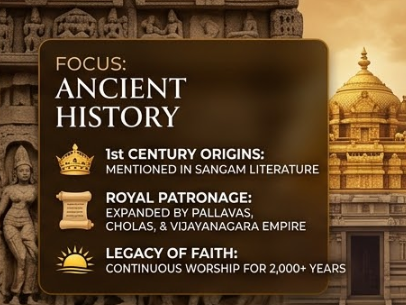
Historically, the Tirumala Venkateswara Temple is extremely ancient. It is mentioned in early Tamil Sangam literature (such as the Silappadikaram) dating back to the 1st century CE.
Over the centuries, the temple was patronized by almost every major dynasty in South India, each contributing to its grandeur:
- The Pallavas: Made the earliest significant endowment to the temple.
- The Cholas: Kings like Rajaraja I expanded the temple structure and made lavish gifts of gold and land.
- The Vijayanagara Empire: Reached the peak of its patronage. King Krishnadevaraya was a devout follower and visited multiple times, donating large amounts of gold, gems, and establishing permanent endowments. The gold-plated dome (Ananda Nilayam) is a legacy of this era.
- The Marathas and the British: Later, the temple came under their administration.
- TTD (Tirumala Tirupati Devasthanams): Since 1933, the temple has been managed by TTD, an independent trust that has modernized the administration while maintaining the sacred traditions.
This rich historical tapestry shows that the Tirumala history is as much about royal patronage as it is about common faith.
3. 10 Amazing and Mysterious Facts About Tirupati Temple

What makes Tirupati Balaji truly extraordinary are the many phenomena that defy scientific logic and rational explanation. Here are 10 amazing facts that add to the temple’s mystique:
- The Richest Temple: It is widely accepted as the richest temple in the world in terms of donations received and wealth owned. The daily Hundi collections regularly amount to millions of Indian Rupees, plus massive donations of gold, silver, and diamonds.
- Kalyana Katta (The Sacred Tonsuring): Millions of devotees, both men and women, shave their heads completely (tonsuring) as an offering of humility and ego. This is based on a myth that Goddess Neela Devi gave her hair to the Lord when his was damaged, and in return, he promised that any devotee offering hair at Tirumala would be blessed.
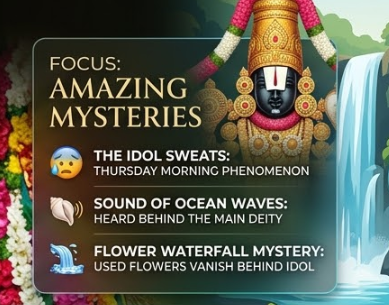
- The Idol’s Sweating: Priests who serve inside the sanctum report that the main idol of Lord Venkateswara sometimes appears to sweat, especially on Thursday mornings. This happens even though the temperature in the sanctum is kept cool. The sweat is gently wiped away with silk cloths by the attendents.
- The Sound of Ocean Waves: If you press your ear to the back of the main idol (a privilege reserved for main priests), it is said that you can clearly hear the sound of crashing ocean waves. This is especially baffling considering the temple is far from the coast.
- The Never-Extinguished Oil Lamps: It is believed that some of the oil lamps (diyas) in the inner sanctum have been burning continuously for centuries, having never gone out.
- The Mythical Flower Waterfall: All the flowers, garlands, and milk used for the Lord’s worship are never thrown away within the temple complex. Instead, they are cast into a secret waterfall (Vaikuntha Tirtham) that drops behind the main idol. It is said that these items wash up far away, near a waterfall in Yerpedu village.
- The Missing Idol Shadow: Similar to other major ancient temples (like Jagannath Puri), it is often said that the main temple dome (Ananda Nilayam) does not cast a shadow on the ground at any time of the day. (Note: This is a widely repeated myth, but its physical verification is often debated.)
- The Off-Center Idol: When you stand in front of the main shrine and look at the Lord, he appears to be standing directly in the center of the sanctum. However, technically and architecturally, the idol is positioned to the right of the exact center.
- Vimana Venkateswara: On the outer dome of the main shrine (Ananda Nilayam), there is a tiny image of Lord Venkateswara carved on the gold plating. It is believed that if you cannot get the main darshan, a glimpse of this “Vimana Venkateswara” is equally auspicious.
- The Unparalleled Wealth Management: The logistics of counting the Hundi donations, processing the tonsured hair (which is a major global export), and managing the massive inflow of pilgrims is considered a miracle of modern management by TTD.
These facts ensure that the Tirupati Temple remains as much a source of wonder as it is of spiritual devotion.
4. The Legendary Tirupati Laddu: Taste of the Divine

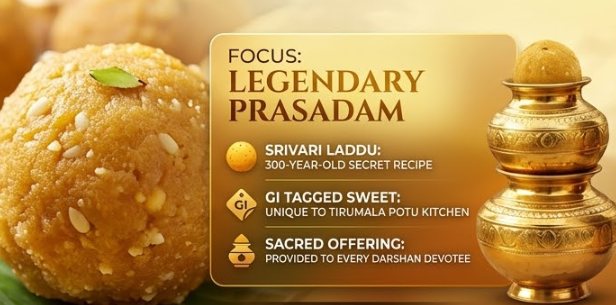
A visit to Tirumala is incomplete without receiving the famous Tirupati Laddu. This is not just a sweet; it is the Srivari Prasadam (the primary food offering) and is legendary for its unique taste, aroma, and shelf-life.
The Tirupati Laddu has been the main prasadam for over 300 years. It is prepared in a massive, strictly controlled kitchen known as the Potu. The recipe is a centuries-old secret, using only the finest ingredients: chickpea flour (besan), pure ghee, oil, sugar, cashews, raisins, and cardamoms.
What makes it so special?
- GI Tag: The Tirupati Laddu has been awarded a Geographical Indication (GI) tag, meaning no other organization or location can legally produce and sell a sweet under this name.
- The Potu: The kitchen uses massive modern machines, but the core preparation remains faithful to tradition.
- Strict Control: The TTD ensures that the quality, weight, and taste of every single laddu are identical.
Every devotee who enters the temple is given at least one laddu as part of their darshan, and millions more are sold daily. It is, without a doubt, the most sought-after prasadam in the world.
5. Grand Festivals and Sacred Sevas
The Tirupati Temple is a place of constant celebration. While daily rituals continue throughout the year, specific festivals are celebrated on a truly massive scale.
Srivari Brahmotsavam

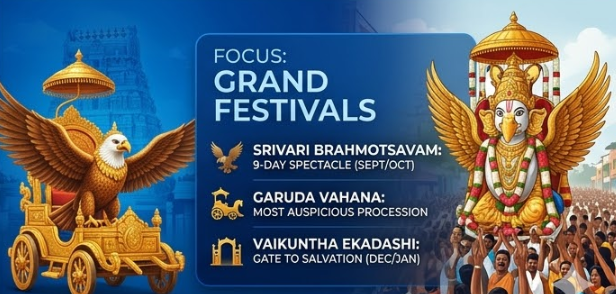
This is the largest and most spectacular festival, usually held over nine days in September or October. Brahmotsavam commemorates the time when Lord Brahma himself is believed to have descended to Earth to perform the first festival for Lord Venkateswara.
During these nine days, the Utsava Murti (processional deity) of Lord Venkateswara, along with his consorts Sridevi and Bhudevi, is taken in grand processions around the temple on different majestic vahanas (vehicles):
- Garuda Vahana: The processing of the Lord on his vehicle, Garuda (the divine eagle), is the most attended and auspicious event of the festival.
- Golden Chariot (Swarna Rathotsavam): A majestic procession where the Lord is taken on a massive chariot made entirely of gold.
Attending Brahmotsavam is considered highly meritorious, and the city of Tirumala is transformed into a world of spiritual music, dance, and lights.
Other Major Festivals
- Vaikuntha Ekadashi: Celebrated in December/January, it is one of the most significant days. The “Vaikuntha Dwaram” (the gate to heaven), which is usually closed, is opened on this day. Devotees believe that passing through this gate leads straight to salvation.
- Rathasapthami: Observed in January/February, often called a “mini-Brahmotsavam,” where the processional deity is taken around on seven different vahanas in a single day, symbolizing the sun god’s seven horses.
The Sacred Sevas
Devotees can also participate in special sevas (services) offered to the Lord. While the main idol is always worshipped, the Utsava Murti is often used for these ceremonies. The most popular seva is the Kalyanotsavam, which represents the celestial wedding of Lord Venkateswara to Goddess Lakshmi and Goddess Padmavathi. Participating in this seva is believed to bring harmony to married life.
Due to extreme demand, online booking for these sevas through the official TTD online portal (tirupatibalaji.ap.gov.in) is essential, often months in advance.
6. How to Plan Your Pilgrimage: A Practical Guide
A visit to the Tirumala Venkateswara Temple requires careful planning. Here is everything you need to know to ensure a smooth darshan experience.
1. Booking Your Darshan (TTD Online)
The official website of the TTD (tirupatibalaji.ap.gov.in) is your single source for all bookings. Never use unauthorized third-party sites.
There are two main types of darshan:
- Special Entry Darshan (Rs. 300): This is the most recommended option. You book a specific time slot (e.g., 10 AM to 11 AM) online, usually 1–2 months in advance. While it still involves some waiting, it is significantly faster than the alternative.
- Sarvadarshan (Free): This is the free darshan, available to all without prior booking. However, the queues can be extremely long, with waiting times often exceeding 20–30 hours during weekends and festivals. TTD has recently introduced time-slotted tokens for Sarvadarshan as well, which you must collect upon arrival in Tirupati town.
2. Accommodation
TTD manages numerous guesthouses and cottages in both Tirupati (downhill) and Tirumala (uphill). These can also be booked online through the official portal. Private hotels and guesthouses are also available, especially in Tirupati town.
3. Dress Code
TTD enforces a strict traditional dress code for everyone entering the temple for any seva or special entry darshan:
- Men: Must wear a Dhoti (white) or a Shirt and Lungi.
- Women: Must wear a Saree or a Chudidar/Salwar Kameez with a Dupatta.
- Prohibited: Jeans, shorts, sleeveless tops, and any western wear are strictly not allowed for Special Entry Darshan.
4. How to Reach Tirupati
- By Air: The nearest airport is Tirupati Airport (Tpt) in Renigunta, which has direct flights from Chennai, Bengaluru, and Hyderabad.
- By Train: The main railway station is Renigunta Junction (Ru), located about 15 km away, or the smaller Tirupati Main (Tpty) station. Both are well-connected to all parts of India.
- By Road: Tirupati has a major bus stand with frequent services from nearby cities like Chennai (135 km) and Bengaluru (250 km). From Tirupati, you take a separate 22 km bus ride up the winding Ghat Road to reach Tirumala.

7. Conclusion: The Collective Power of Faith
A pilgrimage to the Tirupati Temple is more than just a visit; it is an experience that stays with you forever. From the challenging task of securing a ticket, to the endurance of the long queues, to the overwhelming spiritual power of seeing the Lord for those few fleeting seconds, it is a journey that tests and reinforces your faith.
This temple is a living testament to the fact that spirituality is not abstract; it is something you can see, feel, and even taste (in the form of the legendary Tirupati Laddu).
When you stand in that sacred sanctum, surrounded by the echoes of “Govinda! Govinda!”, you realize that you are part of something much larger than yourself. The Tirumala Venkateswara Temple isn’t the richest temple because of the gold it owns; it is the richest because it owns the heart and soul of millions of people. It is the spiritual heartbeat of an entire nation, and its legacy will continue to shine for generations to come.