


“Destruction cannot diminish the power of creation. No matter how many times it is broken, the spirit of a nation, and the faith of a people, will always rise again.”
These words could easily be the mantra of the Somnath Temple. Standing on the western coast of Gujarat, India, at the edges of the Arabian Sea, this magnificent shrine is far more than an ancient building. It is a living, breathing symbol of Indian history’s resilience, the first among the twelve Jyotirlingas, and a testament to the fact that genuine faith is indestructible.
Often called the “Eternal Shrine,” the Somnath Mandir has been a place of immense wealth, profound spirituality, brutal destruction, and triumphant rebuilding, over and over again, for centuries. In this comprehensive article, we will take you on a deep journey through time, exploring the fascinating legends, the complex history, the architectural marvels, and the practicalities of visiting this spiritual powerhouse. Whether you are a devotee seeking blessings, a history enthusiast, or a modern traveler, this is your ultimate guide to the Somnath Temple.
I. Introduction: The Eternal Jyotirlinga
The Somnath Temple is located in Prabhas Patan near Veraval in the Saurashtra region of Gujarat. It is revered as the first and most auspicious of the 12 Jyotirlingas of Lord Shiva. A Jyotirlinga is believed to be a self-manifested radiant pillar of light, representing the supreme, formless power of Shiva.
The name “Somnath” itself holds deep meaning. “Som” refers to Chandra (the Moon God), and “Nath” means Lord. Thus, Somnath is the “Lord of the Moon.” This connection to the moon is not accidental; it is rooted in ancient Vedic mythology.
The temple sits at a unique spot on the Indian coastline, geographically significant and spiritually powerful. For a Hindu, a visit to Somnath is considered essential, often paired with the pilgrimage to Dwarka, making this coastal region of Gujarat a critical spiritual circuit. But what truly makes Somnath Mandir legendary is its undeniable status as a phoenix – a structure that has been razed many times and has always risen from its ashes, grander than before.
II. The Legends and Mythology of Somnath
To understand Somnath Temple, one must first understand the myths that define its sanctity. The legends explain why this specific location is considered the place where the Moon God found salvation.
The Curse of Daksha and Chandra’s Penance
According to the Puranas (ancient Hindu texts), Chandra, the Moon God, was married to 27 daughters of King Daksha Prajapati. These daughters represent the 27 lunar mansions (Nakshatras) of the Hindu zodiac. However, Chandra was deeply attached only to one wife, Rohini, and neglected the other 26 sisters.
The neglected daughters complained to their father. King Daksha, enraged by Chandra’s injustice, cursed him. The curse caused Chandra to gradually lose his luster and light, leading to his waxing and waning phase and eventually to complete darkness (New Moon).
Devastated and powerless, Chandra sought help from Lord Brahma, who advised him to go to the holy site of Prabhas Patan and perform intense penance to Lord Shiva, the master of liberation. Chandra did so, worshipping Shiva at this specific seashore. Satisfied by his devotion, Shiva granted him a boon. While the curse of Daksha could not be entirely undone, Shiva modified it: Chandra would lose his light for 15 days (waning) but regain it for 15 days (waxing), a cycle that continues today.
The First Temple: The Golden Abode
Grateful to Lord Shiva for restoring his light, Chandra decided to build a temple in honor of his Lord. Legend says that the first Somnath Temple was built entirely of gold by the Moon God himself. This first golden temple is lost to time, surviving only in sacred texts and folklore.
Subsequent legends tell of a second temple made of silver by Ravana (the demon king), a third temple made of sandalwood by Lord Krishna, and a fourth temple built of stone by the Vallabhi Kings. These mythological layers establish Somnath Mandir not just as a historical site, but as a place deeply woven into the cyclical understanding of time and the universe.
III. The Historical Saga: A Story of Destruction and Resilience
If mythology gives Somnath Temple its soul, history gives it its legend. The true story of Somnath is a saga of extreme wealth attracting repeat invasions, followed by the indomitable spirit of Indian kings and people to rebuild their eternal shrine.
Early History and Prosperity
The first historically documented temple at Somnath was rebuilt in stone, likely between the 4th and 6th centuries CE by the Vallabhi kings of Gujarat. During this period, and later under the Solanki (Chalukya) kings, the temple grew immensely prosperous. Its location on the ancient trading routes across the Arabian Sea meant it received massive offerings from merchants, kings, and commoners.
It is said that the temple was fabulously wealthy, possessing entire villages for its maintenance and thousands of priests, dancers, and musicians. This wealth, however, became its biggest curse.
The Dark Ages: Mahmud of Ghazni’s Devastation (1026 AD)
The most devastating event in Somnath’s history was the invasion by Mahmud of Ghazni in 1026 AD. Mahmud, a central Asian conqueror, had heard of the immense riches of the temple. He led a massive army across the desert to reach Prabhas Patan.
The defense of Somnath was heroic. Legends say that thousands of people (some accounts say 50,000) sacrificed their lives trying to protect their beloved temple. However, Mahmud’s forces were superior. He sacked the city, entered the temple, broke the main Jyotirlinga, and systematically destroyed the temple structure. He looted an astronomical amount of gold, silver, and precious gems, carrying them back to Ghazni. This event is etched deeply in the collective memory of India, symbolizing a moment of great trauma and religious persecution.
The Cycle of Rebuilding
Despite the complete devastation by Ghazni, the Somnath Temple was rebuilt almost immediately.
- 1030 AD: King Bhoj of Parmar dynasty (Malwa) and King Bhimdev I of Solanki dynasty (Gujarat) reconstructed the temple.
- 1169 AD: Another reconstruction was carried out by King Kumarapala.
The wealth returned, and so did the invasions:
- 1299 AD: Allauddin Khilji’s army under Ulugh Khan sacked and destroyed the temple. Rebuilt by local kings.
- 1395 AD: Zafar Khan of the Gujarat Sultanate destroyed it. Rebuilt.
- 1451 AD: Mahmud Begada sacked it. Rebuilt.
- 1706 AD: The most final historical destruction was carried out by the Mughal Emperor Aurangzeb, who ordered the temple to be demolished completely and a mosque built over its site.
Each time the temple was broken, it was rebuilt, symbolizing the refusal of the local populations to give up their spiritual heart. For over two centuries (from the early 18th century to the mid-20th century), the original Somnath Mandir existed primarily as a pile of ruins.
IV. The Modern Phoenix: Reconstruction After Independence

The story of modern Somnath Temple is a saga of national integration, political conviction, and a unified vision. It is perhaps the most unique story of post-independence India’s connection to its spiritual roots.
The Situation in 1947
When India gained independence in 1947, the site of the ancient Somnath Temple was in the princely state of Junagadh. The Nawab of Junagadh attempted to accede to Pakistan. This led to a public uprising, and the Indian government sent troops to maintain order. Junagadh officially joined India.
In November 1947, Sardar Vallabhbhai Patel, the “Iron Man of India” and the first Home Minister, visited the ruins of Somnath. He was deeply moved by the state of the eternal shrine. On the seabeach of Prabhas Patan, he made a public pledge: “The Government of India and the people of India will not rest until this eternal shrine of Somnath is rebuilt at its original place, in all its pristine glory.”
Visionaries of the Reconstruction
This vision faced challenges. Some within the government (including Prime Minister Jawaharlal Nehru) felt that the state should not involve itself directly in religious projects, particularly a contentious one, preferring to build modern secular institutions.
However, Sardar Patel, along with K.M. Munshi (a distinguished writer and politician), and with the moral support of Mahatma Gandhi, was resolute. Gandhi advised that the project should not be funded by the government but by public donations, ensuring it truly belonged to the people of India.
The ‘Shree Somnath Trust’ was formed to manage the reconstruction and administration of the temple.
Prana Pratistha (1951)
The reconstruction began at the original location. In May 1951, the first President of India, Dr. Rajendra Prasad, was invited to perform the Prana Pratistha (consecration of the new Jyotirlinga). Despite political opposition from the Prime Minister’s office, Dr. Prasad attended, making a historic speech. He declared that Somnath Mandir was not just a religious structure, but a “symbol of the victory of construction over destruction, of resilience over brutality.”
This event marked the official rebirth of Somnath, signaling post-independence India’s commitment to restoring its cultural heritage. The new temple, completed later in 1995, stands today on the very foundations that were laid and destroyed centuries ago.
V. Architectural Marvel: The Kailash Mahameru Prasad
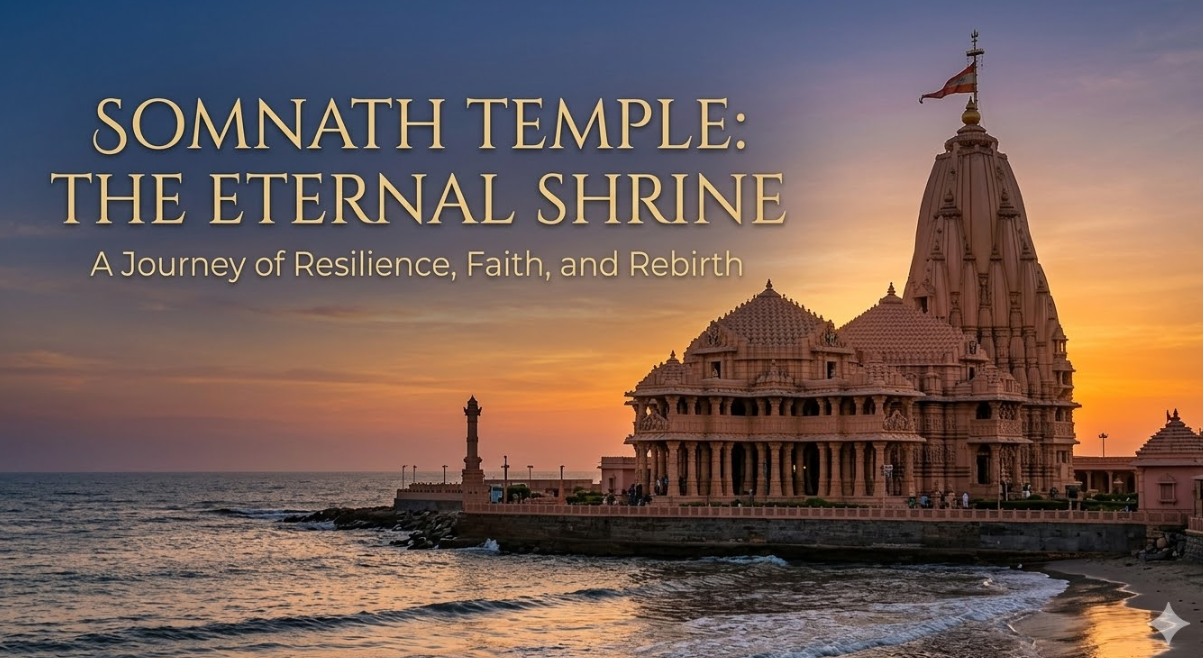
The current Somnath Temple is a masterpiece of modern-day temple architecture, meticulously designed to honor the ancient style. It is built in the Chalukya (Solanki) architectural style of Gujarat, reflecting the temple’s peak period of 12th-century grandeur.
Structure and Design
The temple is called “Kailash Mahameru Prasad” (Palace of Kailash, the sacred mountain). It is built primarily of pink sandstone from Rajasthan, known for its durable and beautiful finish.
The temple complex consists of three main structures:
- Garbhagriha (Sanctum Sanctorum): The square chamber where the main Jyotirlinga resides. It is the innermost part of the temple, quiet and powerful. The main shrine features a large silver door, intricately carved.
- Gudhamandapa (Audience Hall): The main hall leading to the sanctum. It has a beautiful, highly decorated dome.
- Nrityamandapa (Dance Hall): The spacious hall where cultural and devotional performances are held.
Intricate Details
The entire temple, inside and out, is covered in exquisite carvings. These include figures of deities, celestial musicians, flying apsaras, and historical scenes. The main shikhara (spire) above the sanctum is a curvilinear tower that rises to a height of 155 feet, topped by a large Kalash (pot) and a flag.
The pillars (stambhas) are a key feature, carved with intricate geometric and floral patterns, characteristic of the Solanki style. The architecture seamlessly blends powerful geometry with delicate artistry. Standing inside the mandap, one feels a profound sense of awe and spiritual connection, a “human touch” that goes beyond words.
The Mysterious ‘Baan Stambh’ (Arrow Pillar)
On the seashore, near the temple complex, stands a unique and ancient pillar known as the ‘Baan Stambh’ (Arrow Pillar). It has a small arrow pointing towards the south, over the vast Arabian Sea. An ancient inscription on the pillar states that it is located at the specific point from where there is no piece of land in a straight line until the South Pole.
This baffling ancient knowledge is a source of great interest, as modern geography has confirmed this to be true. This demonstrates that ancient Indian geographers had an advanced understanding of the world’s map. This mystery adds another layer to the wonder of Somnath Mandir.
VI. Practical Guide for Pilgrims Visiting Somnath
A visit to the Somnath Temple requires preparation to ensure a smooth and meaningful experience. Here is a practical guide with all the essential information:
Temple Timings and Rituals
The temple is open to all throughout the year. The primary timings are:
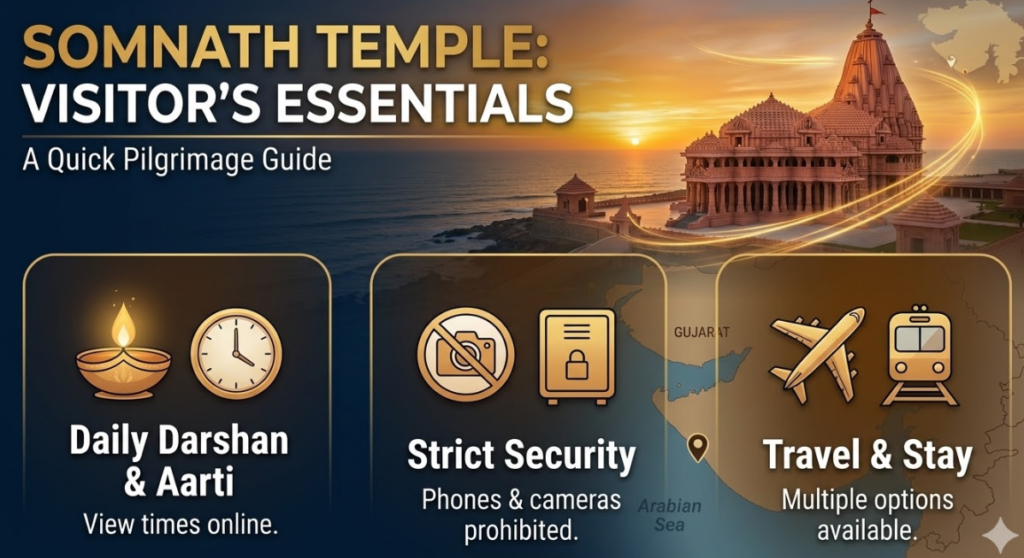
- Darshan Timings: 6:00 AM to 9:30 PM daily.
- Aarti Timings: 7:00 AM, 12:00 Noon, and 7:00 PM.
- Light and Sound Show (Somnath Mahatmya): A spectacular daily show (weather permitting) at 7:45 PM to 8:45 PM, narrating the temple’s history and legends in Hindi, is highly recommended. Ticket booking is required.
Dress Code
Like most major temples in India, a conservative dress code is strictly enforced:
- For Men: Traditional wear like Dhoti, Kurta-Pajama, or Shirt and Trousers. Avoid wearing shorts or sleeveless shirts.
- For Women: Sarees, Chudidar-Salwar Kameez with a Dupatta. Avoid wearing modern Western wear like skirts or tight clothes.
- Note: Specific sevas (like performing abhishek) require very strict traditional attire (Dhoti without shirt).
Security and Entry Restrictions
Security at Somnath Temple is extremely high. All personal belongings, including mobile phones, cameras, leather items (wallets, belts), and any large bags, are strictly prohibited inside the main temple premises. Extensive locker facilities are available near the entrance to store your belongings. Entry requires passing through metal detectors and a full body search.
How to Reach Somnath
- By Air: The nearest airport is Keshod Airport (IXK) (approx. 55 km away), which has limited regional flights. A more major airport is Diu Airport (DIU) (approx. 90 km away) which has better connectivity. Rajkot (approx. 195 km away) and Ahmedabad (approx. 400 km away) are the largest airports in Gujarat with excellent global connectivity.
- By Train: The nearest major railway station is Veraval Junction (VRL), located just 5-7 km from the temple. It has direct trains from Ahmedabad, Vadodara, Mumbai, and other major Indian cities. Taxis and auto-rickshaws are easily available from the station.
- By Road: Somnath is well-connected by a network of National Highways to other parts of Gujarat and nearby states. Frequent state and private bus services operate from Ahmedabad, Rajkot, Dwarka, Diu, and Bhavnagar. The scenic coastal drive from Dwarka to Somnath is very popular.
Accommodation
The ‘Shree Somnath Trust’ manages several high-quality, economical guesthouses and cottages (Yatri Niwas) near the temple, which can be booked online through the official temple website (somnath.org). Private hotels and resorts are also available in Veraval and Somnath town.
Nearby Attractions to Complete Your Pilgrimage
A trip to Somnath is incomplete without visiting these nearby sacred sites:
- Triveni Sangam: The holy confluence of three rivers—Hiran, Kapila, and the mythical Saraswati—before they meet the Arabian Sea. Devotees take a ritual bath here before visiting the main temple.
- Gita Mandir: A beautiful temple dedicated to the Bhagavad Gita, containing all the verses of the Gita carved on its marble walls.
- Bhalka Tirth: A deeply significant location (approx. 5 km away) where Lord Krishna is believed to have been accidentally shot by an arrow from a hunter, ending his earthly Lila. A serene temple marks this spot.

VII. Conclusion: The Collective Power of Faith
The Somnath Temple is more than just a place of worship; it is a mirror reflecting the grand saga of Indian history and spirituality. It is a place where mythology meets documented fact, where brutal destruction is countered by relentless reconstruction, and where individual devotion merges into a collective national consciousness.
Visiting Somnath is not merely a check-box on a travel itinerary; it is an experience that forces you to confront the impermanence of physical structures and the eternal nature of faith. The sound of the Arabian Sea crashing against the temple walls, the echo of “Jai Somnath” (victory to Somnath), the intricate beauty of the sandstone carvings, and the sheer audacity of a structure that refuses to be broken – these elements combine to leave an indelible mark on your soul.
Whether you are seeking the grace of the first Jyotirlinga, looking for architectural inspiration, or just wanting to understand the enduring power of faith, the Somnath Mandir stands as an eternal beacon, inviting all. Its light has been extinguished many times, but its spirit has proven that it is truly eternal.