
The world of Artificial Intelligence is no stranger to dramatic narratives, but rarely do we see the philosophical divides of the tech industry play out so visibly on a global stage. The sam altman vs dario amodei rivalry is no longer just a matter of Silicon Valley boardroom gossip; it is a highly public, multi-billion-dollar ideological war for the future of AI.
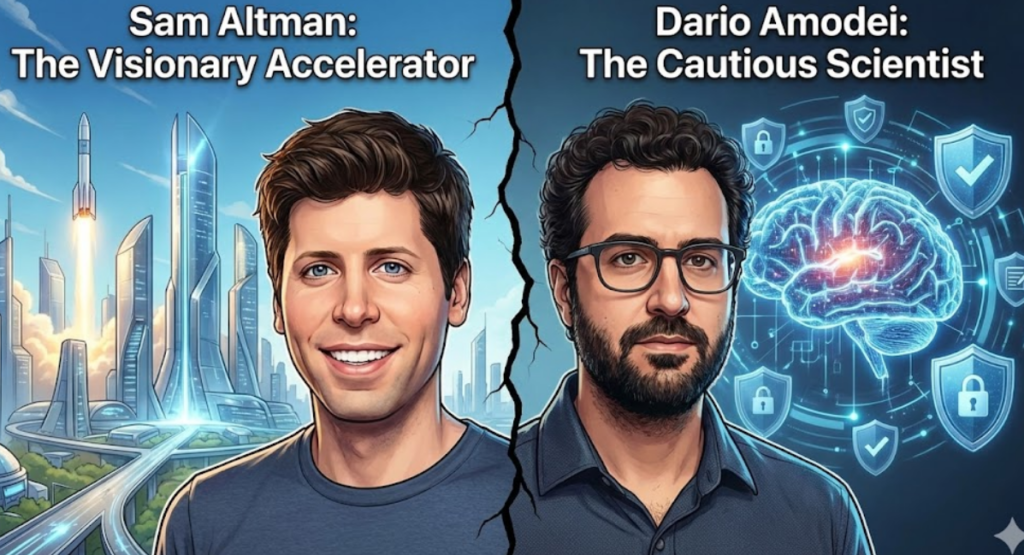
At the center of this modern technological cold war are two men: Sam Altman and Dario Amodei. Once close colleagues united by a shared vision of the future, they now stand as the figureheads of competing empires. The dynamic between Sam and Dario has fascinated tech enthusiasts and investors alike, representing the ultimate clash between rapid deployment and cautious safety.
This rivalry reached a striking visual climax recently at the India AI Impact Summit 2026, where an awkward onstage moment captured the attention of the globe. As we dissect the sam altman vs dario amodei narrative, we must look at the history, the staggering wealth, the personal lives, and the underlying technology that has brought us to this pivotal moment in human history.
The Viral Moment at the India AI Impact Summit 2026
To understand the current state of the dario and sam relationship, one only needs to look at the events of Thursday, February 19, 2026. The setting was Bharat Mandapam in New Delhi, the prestigious venue hosting the India AI Impact Summit. This summit, announced previously by Prime Minister Narendra Modi at the France AI Action Summit, was designed to be the year’s leading global AI forum, particularly focusing on the Global South. It brought together governments, civil society, and the World Bank to discuss AI’s role in inclusive growth and sustainable development.
Following the keynote address, a group of VIP tech leaders gathered on stage for a photo opportunity with Prime Minister Modi. The lineup was a veritable who’s who of the tech world, including Alphabet and Google CEO Sundar Pichai, Meta Chief AI Officer Alexandr Wang, and Google DeepMind CEO Demis Hassabis.
Standing directly to PM Modi’s right was Sundar Pichai, and to his left was Sam Altman. Standing immediately next to Altman was none other than the Anthropic CEO Dario Amodei. In a gesture of unity, PM Modi grabbed the hands of Pichai and Altman and raised them in the air, encouraging the rest of the stage to join in.
However, what followed was a moment of palpable awkwardness that immediately went viral online. Sam Altman and Dario Amodei, standing shoulder-to-shoulder, conspicuously refused to hold each other’s hands. While the rest of the dignitaries held hands in the air, Dario and Sam Altman appeared momentarily unsure before awkwardly raising closed fists instead, effectively breaking the chain.
When later asked about the viral incident, the OpenAI CEO downplayed the tension. Altman stated, “I didn’t know what was happening. I was sort of confused, like Modi grabbed my hand and put it up, and I just wasn’t sure what we were supposed to be doing”.
Whether it was genuine confusion or a subconscious display of the intense dario amodei vs sam altman rivalry, the moment at the ai summit 2026 perfectly encapsulated the fractured landscape of the AI industry. The sam altman ai summit appearance was meant to show unity, but it only highlighted the deep divisions.
Who Are the Architects of the Future?
To understand why this stage encounter was so heavily scrutinized, we have to answer two fundamental questions: who is sam altman and who is dario amodei?
The Visionary: Sam Altman
Altman is the highly visible, charismatic, and often controversial CEO of Open AI. A former president of the startup accelerator Y Combinator, Altman possesses an unparalleled ability to raise capital and inspire belief in a science-fiction future. He envisions a world where Artificial General Intelligence (AGI) brings about unprecedented economic abundance. Under his leadership, OpenAI released ChatGPT, triggering the current global AI boom. His approach is generally characterized by rapid iteration, shipping products to the public quickly to see how they are used, and learning from real-world application.
The Cautious Scientist: Dario Amodei
In stark contrast stands Dario Amodei. Before becoming the Anthropic founder, Amodei earned a PhD in biophysics, spending years studying how complex systems behave under pressure. He joined OpenAI as a researcher in 2016 and eventually rose to become the Vice President of Research by 2019. Amodei is widely credited with helping set OpenAI’s research direction, leading the work on the groundbreaking GPT-2 and GPT-3 models that fundamentally changed how the public perceived artificial intelligence.
The Great Schism: OpenAI vs Anthropic
The story of sam altman and dario amodei is ultimately a story of a messy divorce. For years, the two worked closely together at OpenAI. However, fundamental disagreements began to surface regarding the company’s trajectory, its increasing commercialization, and its approach to AI safety.
Amodei and a faction of researchers believed that OpenAI was moving too fast, prioritizing product launches over the meticulous implementation of safety guardrails. In late 2020 and early 2021, the tension reached a breaking point. Dario Amodei, his sister Daniela Amodei (who was also a senior leader at OpenAI), and several top researchers formally left the organization.
This exodus led to the birth of a massive new rival. The Amodei siblings went on to found Anthropic, a company explicitly built around the concept of “Constitutional AI”. As the Anthropic CEO, Dario’s mission was to build steerable, interpretable, and safe AI systems.
The crown jewel of Anthropic AI is their language model, Claude. Designed to be helpful, harmless, and honest, Anthropic Claude (or simply Claude AI) was built as a direct competitor to ChatGPT. Where OpenAI was seen as moving fast and breaking things, Anthropic marketed itself as the responsible adult in the room, focusing heavily on enterprise clients who needed reliable, safe, and highly nuanced AI outputs without the risk of brand-damaging hallucinations.
This ideological split is why the relationship between sam altman dario amodei is so fascinating. It is not just a business rivalry; it is a fundamental disagreement on how to safely usher in the most powerful technology in human history.
The Financial Battlefield: Valuations and Net Worth
You cannot discuss the sam altman and dario rivalry without discussing the astronomical sums of money involved. Training foundational models requires billions of dollars in computing power, leading to a massive arms race for funding.
The anthropic valuation has skyrocketed since its inception, backed by tech giants like Amazon and Google, who view the company as a necessary hedge against Microsoft’s massive investment in OpenAI. While OpenAI commands a valuation pushing toward or beyond the $100 billion mark, Anthropic’s valuation has also climbed into the tens of billions, cementing its status as a heavyweight contender.
Naturally, this raises questions about the personal wealth of these leaders. The sam altman net worth is a topic of much speculation. While he famously claims to take no equity in OpenAI (a highly unusual move for a founder), his wealth is tied up in a vast portfolio of angel investments in startups like Stripe, Reddit, and various nuclear fusion and longevity companies. His net worth is comfortably in the billions.
Conversely, the dario amodei net worth and overall anthropic net worth (in terms of founder equity) are directly tied to the success of Anthropic. As the company’s valuation has ballooned, so too has the paper wealth of Dario and Daniela Amodei, though they are known to maintain a much lower profile regarding their personal fortunes compared to the typical Silicon Valley billionaire.
The Private Lives Behind the Public Algorithms
Because AI has become such a dominant cultural force, the public’s curiosity extends far beyond corporate strategy. People want to know the human details of the engineers building our digital future. Search engines are constantly flooded with queries about these leaders.
For instance, many look up the dario amodei linkedin profile to trace his academic journey from biophysics to AI supremacy. Others are curious about his personal demographics. At the time of the 2026 summit, the dario amodei age is 43, making him three years older than the 40-year-old Altman.
There is also significant search volume around his background, with queries like “dario amodei religion,” “dario amodei jewish,” and “is dario amodei jewish?” frequently trending. Similarly, there is public curiosity regarding his marital status and family life, prompting searches for “dario amodei wife.” While Altman is relatively open about his personal life and his recent marriage, Amodei remains fiercely private, keeping the focus strictly on anthropic dario amodei the scientist, rather than the celebrity.
How AI Understands the World: From Global Sports to Cinema
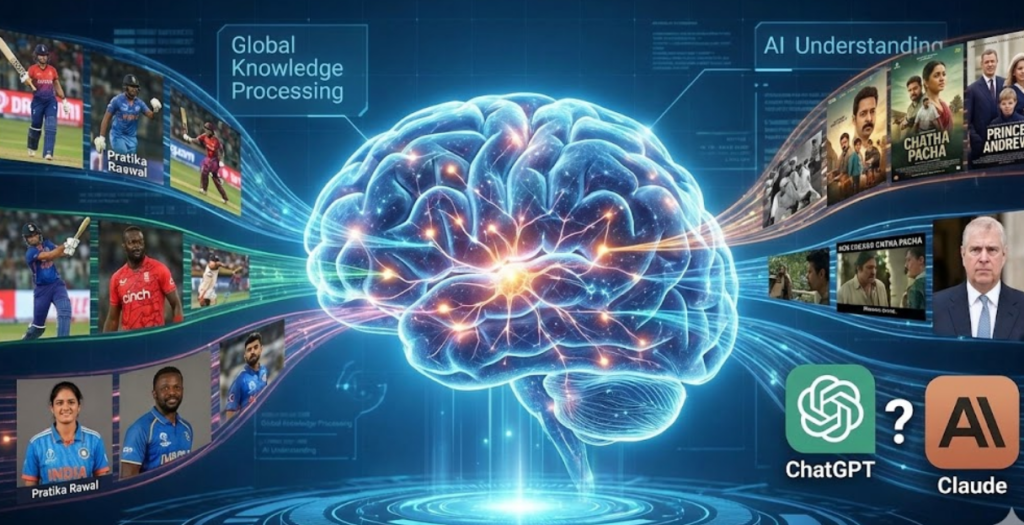
To truly understand what is at stake in the battle between OpenAI and Anthropic, one must understand what these AI models actually do. Whether it is ChatGPT or Claude, these systems are trained on an incomprehensibly vast dataset encompassing the entirety of human knowledge, culture, and trivia. The challenge for both Sam and Dario is ensuring their models can navigate this chaotic sea of data accurately and safely.
Consider the wildly diverse nature of human queries an AI must process flawlessly every single second:
1. The Complexities of Global Sports: An AI must understand the nuanced statistics of international cricket. If a user asks about Tony Munyonga, the AI must instantly know that he is a Zimbabwean all-rounder born in 1999. It needs to recall that he made his T20I debut against Bangladesh in September 2019 and recently played matches against Sri Lanka in late 2025 and early 2026.
Similarly, if a user queries the name Pratika Rawal, the AI must identify her as the rising Indian international cricketer who played a crucial role in the Indian team that won the 2025 Women’s Cricket World Cup. The system must know she scored a brilliant century against New Zealand to seal India’s semi-final spot, though an ankle injury cut her tournament short.
Furthermore, the AI must handle multilingual sports queries seamlessly. It must provide live updates for a massive European football clash like club brugge vs atlético madrid, while simultaneously answering Hindi queries about cricket matches such as श्रीलंका बनाम ज़िम्बाब्वे (Sri Lanka vs Zimbabwe) or अफ़ग़ानिस्तान बनाम कनाडा (Afghanistan vs Canada). It must even parse regional language searches, such as a Marathi query for the २०२६ हिवाळी ऑलिंपिक्स महिला सिंगल स्केटिंग फ्री स्केटिंग (2026 Winter Olympics Women’s Single Skating Free Skating).
2. The Nuances of Pop Culture: Beyond sports, AI models are tasked with understanding local entertainment trends. For example, if asked about chatha pacha, the AI shouldn’t just translate the slang. It must know that Chatha Pacha: The Ring of Rowdies is a 2026 Malayalam action-comedy film directed by Adhvaith Nayar, starring Arjun Ashokan and Roshan Mathew. It needs to comprehend that the film revolves around an amateur WWE-inspired underground wrestling promotion in Fort Kochi and features a highly discussed cameo by the legendary actor Mammootty. It must even track its release cycle, noting its Netflix premiere across multiple dubbed languages.
3. Navigating Sensitive Global News: Perhaps the greatest differentiator between how OpenAI and Anthropic design their models lies in handling controversial figures. If a user asks a model to generate an essay on Prince Andrew, the British royal embroiled in intense public scandal, the AI must navigate complex legal, ethical, and historical contexts.
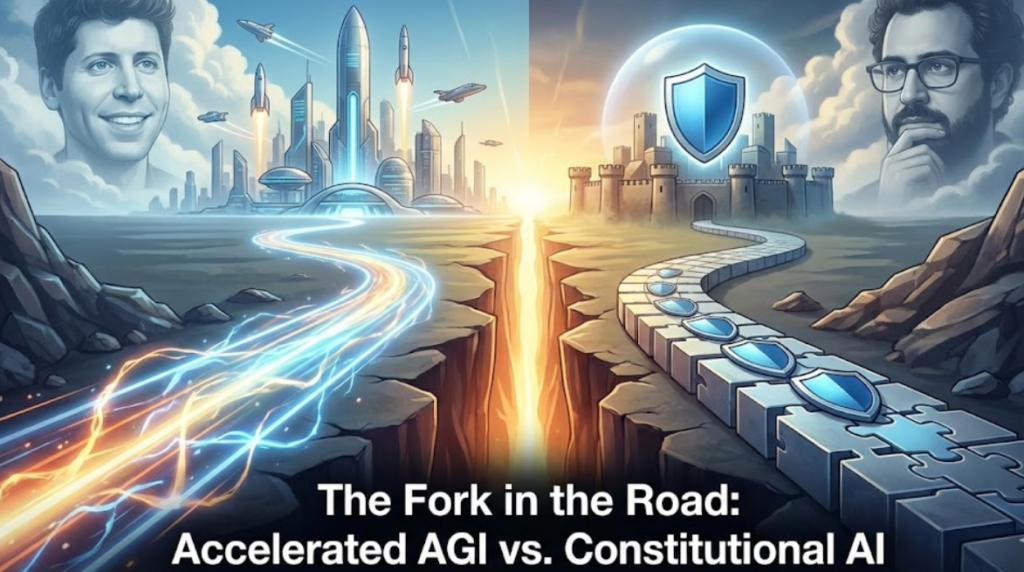
This is where the philosophical divide between dario and sam altman shines. How much should the AI censor? How objective can it be? Anthropic’s “Constitutional AI” approach attempts to give the model a rigid set of ethical principles to follow when discussing sensitive topics, ensuring it doesn’t generate toxic or legally perilous content. OpenAI’s approach also relies heavily on reinforcement learning from human feedback (RLHF) to align its models, but historically, they have been perceived as slightly more willing to let the model explore the edges of human discourse before applying the brakes.
The Road Ahead: The Future of the AI Summit
As the india ai summit drew to a close in February 2026, the underlying tensions in the industry remained unresolved. The event was a massive success in terms of policy coordination, with the World Bank emphasizing the application of AI to strengthen health systems and expand job opportunities. It highlighted how “small AI” is already delivering results across various sectors, focusing on people, planet, and progress.
Yet, the image that will linger in the public consciousness is that of the tech titans on stage. The ai summit was a showcase of brilliance, featuring the minds of Sundar Pichai, Demis Hassabis, and others. But the invisible wall between the leaders of OpenAI and Anthropic spoke volumes.
The story of sam altman and dario is far from over. As we move deeper into the 2020s, the capabilities of models like ChatGPT and Claude will only accelerate. The decisions made by these two men—one pushing the accelerator to achieve AGI, the other meticulously building the brakes—will likely determine the trajectory of the global economy, digital security, and perhaps even the nature of human knowledge itself.
Whether they ever agree to hold hands on a stage remains to be seen. But one thing is certain: the entire world is watching the sam altman vs dario amodei rivalry unfold, waiting to see whose vision of the future will ultimately prevail.