
The landscape of higher education in India is undergoing a massive transformation. With the implementation of the National Education Policy (NEP) 2020 and updated UGC regulations, PhD admission 2026 is set to be more dynamic, flexible, and research-oriented than ever before.

Whether you are a fresh post-graduate dreaming of the lush campuses of JNU and IISc, or a working professional eyeing a part-time PhD at an IIT, this guide covers it all. We will decode the complex web of entrance exams like UGC NET 2026, GATE 2026, and university-specific tests to help you secure your seat in India’s premier institutions.
1. Why Pursue a PhD in 2026?
A Doctor of Philosophy (PhD) is the highest academic degree one can achieve. In 2026, a PhD is no longer just about becoming a professor; it is a gateway to high-paying roles in R&D, corporate consultancy, policy-making, and think tanks.
The Changing Landscape
- Direct PhD after 4-Year UG: One of the biggest shifts is the eligibility for 4-year undergraduate degree holders to apply directly for a PhD, bypassing the Master’s degree requirement.
- Interdisciplinary Research: Institutes like IIT Gandhinagar and IIT Madras are breaking departmental silos, allowing you to combine fields like Artificial Intelligence with Psychology or Data Science with History.
- Fellowship Hikes: With the PMRF (Prime Minister’s Research Fellowship) offering up to ₹80,000 per month, research is becoming a financially viable career choice.
2. Eligibility Criteria for PhD Admission 2026
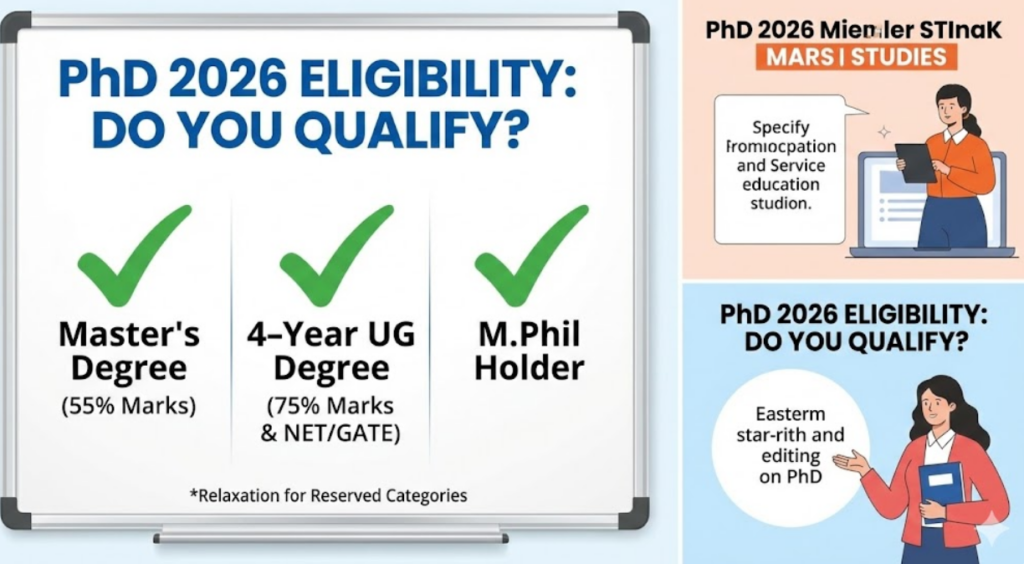
Before you start preparing, you must check if you fit the bill. The UGC has standardized eligibility, but institutes like IIT Bombay or IISc Bangalore may have higher cut-offs.
A. For Master’s Degree Holders
- Qualification: You need a 1-year/2-semester Master’s degree after a 4-year/8-semester Bachelor’s degree OR a 2-year/4-semester Master’s degree after a 3-year Bachelor’s degree.
- Minimum Marks: At least 55% marks in aggregate or its equivalent grade ‘B’ in the UGC 10-point scale.
- Relaxation: A relaxation of 5% (from 55% to 50%) is allowed for candidates belonging to SC/ST/OBC (Non-Creamy Layer)/Differently-Abled categories.
B. For 4-Year Undergraduate Degree Holders (Direct PhD)
- Qualification: Candidates with a 4-year/8-semester Bachelor’s degree (like B.Tech, B.S.) can apply directly.
- Minimum Marks: A minimum of 75% marks in aggregate or its equivalent grade is required.
- Note: If you are applying directly after a 4-year UG degree, clearing UGC NET 2026 or GATE 2026 is often mandatory for admission and fellowships.
C. For M.Phil Holders
- Candidates who have completed an M.Phil with at least 55% marks are eligible for direct admission to PhD programs.
3. The Gatekeepers: National Entrance Exams 2026
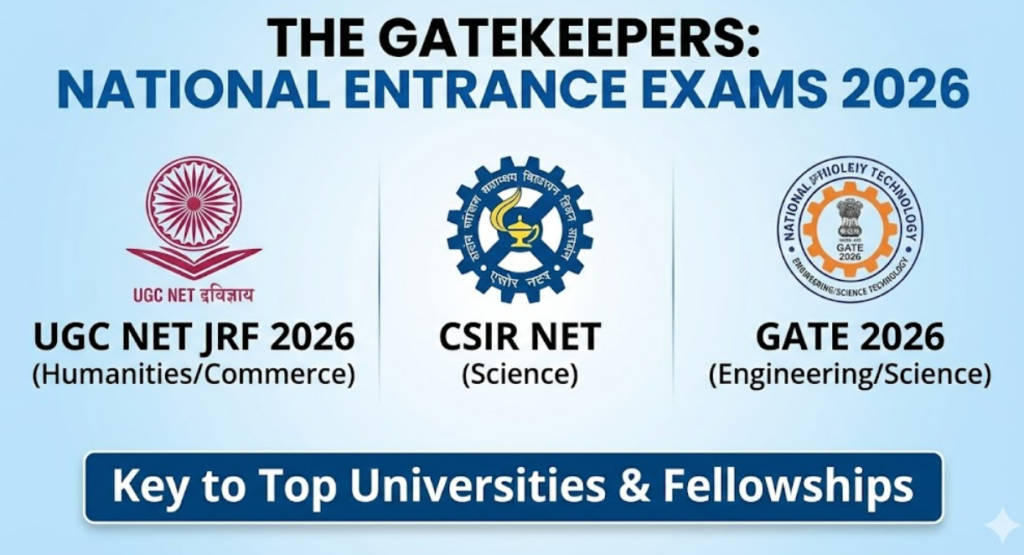
To get into top-tier universities, you must clear national-level exams. In 2026, these scores are more critical than ever as many universities are scrapping their own entrance tests in favor of NET/GATE scores.
A. UGC NET 2026 (For Humanities, Commerce, & Social Sciences)
The UGC NET (National Eligibility Test) is the most popular exam for non-science streams.
- Exam Cycle: It is conducted twice a year, typically in June and December.
- Expected Dates: For the June cycle, the application form is expected in March-April 2026, with exams in June 2026.
- Three Categories of Results:
- Award of JRF & Appointment as Assistant Professor: The golden ticket. You get a fellowship and can teach.
- Appointment as Assistant Professor & Admission to PhD: You can teach and get PhD admission but without the JRF scholarship.
- Admission to PhD Only: You are eligible for PhD interviews but not for teaching jobs or JRF.
B. CSIR NET 2026 (For Science Streams)
For students in Life Sciences, Physical Sciences, Chemical Sciences, etc., CSIR NET is the equivalent of UGC NET.
- Fellowship: The JRF amount is identical to UGC NET.
- Top Institutes: Scores are accepted by CSIR labs, IITs, and IISERs.
C. GATE 2026 (For Engineering & Sciences)
The Graduate Aptitude Test in Engineering (GATE) is the primary route for IIT PhD admission and IISc Bangalore.
- Exam Date: Usually held in February 2026.
- Validity: GATE scores are typically valid for 3 years, giving you flexibility in applying.
- Importance: A high GATE score is mandatory for Institute Fellowships (HTRA) in IITs.
D. University Specific Exams (RET)
Institutes like BHU (Banaras Hindu University), Lucknow University, and AMU (Aligarh Muslim University) conduct their own Research Entrance Test (RET).
- Exemption: If you have cleared NET/GATE, you are often exempted from the written RET and directly called for the interview.
4. Top Institutes: Admission Process & Timelines
Knowing when to apply is as important as how. Here is a breakdown of the admission cycles for India’s elite institutions.
A. IIT PhD Admission 2026
The Indian Institutes of Technology (IITs) generally have two admission cycles:
- Autumn Semester (starts July/Aug): Applications open in March/April.
- Spring Semester (starts Jan): Applications open in September/October.
- IIT Bombay: Known for its rigorous interview. They offer PhDs in regular, sponsored, and external categories.
- IIT Delhi: Focuses heavily on interdisciplinary centers like the School of Public Policy or AI.
- IIT Madras & IIT Gandhinagar: Known for offering “Early PhD” programs for bright B.Tech students.
- Admission Tip: IITs require a “Statement of Purpose” (SOP). Ensure your research interests align with a faculty member’s work before applying.
B. IISc Bangalore PhD Admission
IISc is the holy grail for science research in India.
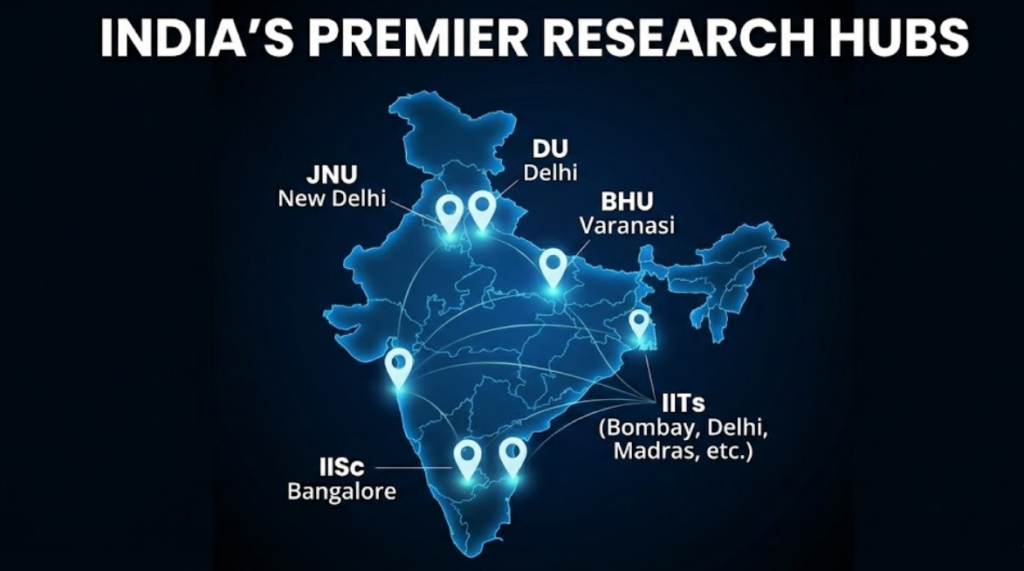
- Process: Admission is strictly through GATE/NET/JEST scores followed by a technical interview.
- Timeline: Applications usually open in February 2026 immediately after GATE results.
C. Central Universities (JNU, DU, BHU, AMU)
- JNU PhD Admission 2026: Admission is largely through UGC NET scores (JRF category) and a separate entrance for non-NET candidates (if seats remain). JNU is famous for its viva-voce (interview) where your research proposal is scrutinized.
- Delhi University (DU) PhD Admission: DU has moved towards using NET scores. The interview process is decentralized, meaning each department (e.g., Department of History, Department of Physics) conducts its own selection.
- BHU PhD Admission: Offers a massive number of seats across disciplines. The RET is competitive, but the campus offers a rich residential experience.
D. IGNOU PhD Admission 2026
For those who cannot commit to a full-time residential program, IGNOU is a viable option.
- Clarification: IGNOU offers Regular Mode PhDs with strict coursework requirements, not “distance” PhDs (which are invalid).
- Entrance: IGNOU conducts a national-level entrance test, usually in January or July.
5. Financial Support: Fellowships & Scholarships
Money matters. A PhD is a long commitment (3-5 years), and financial stability is crucial.
A. Prime Minister’s Research Fellowship (PMRF)
This is India’s most prestigious fellowship.
- Amount: ₹70,000 to ₹80,000 per month + ₹2 Lakhs annual research grant.
- Eligibility: Top-ranking students from IITs/NITs/IISERs or GATE/NET qualified candidates selected by granting institutes.
- Selection: It has a rigorous two-stage selection process involving a lateral or direct entry channel.

B. Junior Research Fellowship (JRF)
- Source: UGC or CSIR.
- Amount: Approximately ₹37,000 per month (JRF) + HRA. After two years, it upgrades to Senior Research Fellowship (SRF) with a hike to ~₹42,000/month.
C. Institute Fellowship (HTRA)
- Source: Provided by institutes like IITs to GATE qualified students.
- Duty: Requires 8 hours of teaching assistance (TA) work per week.
6. Part-Time PhD: A Boon for Working Professionals
The UGC PhD Regulations now strongly encourage part-time PhDs to foster industry-academia linkage.
Who is it for?
- Working professionals in corporate jobs, government officers, or faculty members in other colleges.
- Key Requirement: You must submit a “No Objection Certificate” (NOC) from your employer stating they have no issue with your research work.
Difference from Full-Time
| Feature | Full-Time PhD | Part-Time PhD |
| Duration | 3-5 Years | 4-7 Years (Flexible) |
| Residency | Stay on campus | Minimum stay required for coursework (e.g., 1 semester) |
| Fellowship | Eligible for JRF/PMRF | usually Not Eligible for government fellowship |
| Work Status | Cannot hold a job | Can continue working |
- Top Institutes for Part-Time: IIT Delhi, DTU, BITS Pilani, and VIT have robust part-time PhD programs.
7. How to Apply: A Step-by-Step Guide
- Identify Your Area: Don’t just say “Physics.” Narrow it down to “Condensed Matter Physics” or “Astrophysics.”
- Clear the Exam: Ensure you have a valid UGC NET 2026 or GATE 2026 score.
- Prepare a Research Proposal: This is the most critical document. It should include:
- Title of the Project.
- Literature Review (What work has already been done?).
- Research Gap (What is missing?).
- Methodology (How will you solve it?).
- Apply Online: Keep an eye on university portals (IITs in March/Sept, Universities in June/July).
- Ace the Interview: Be prepared to defend your proposal. Read the interview panel’s research papers beforehand.
Conclusion
PhD Admission 2026 is a journey of patience and persistence. Whether you are aiming for the high-tech labs of IIT Bombay, the critical thinking hubs of JNU, or the flexible environment of Lucknow University, the opportunities are vast.
The key to success lies in starting early. Don’t wait for the notification to release. Start working on your research proposal today, prepare for UGC NET/GATE, and reach out to potential supervisors. The title of “Doctor” is waiting for you!
Frequently Asked Questions (FAQs)
Q1. Can I do a PhD through distance mode in 2026?
No. As per UGC regulations, PhD via distance mode is NOT valid. However, you can opt for a Part-Time PhD, where you attend coursework classes but conduct research while working.
Q2. Is UGC NET mandatory for PhD admission 2026?
For many Central Universities like DU and JNU, UGC NET scores are now the primary criteria. However, some universities still conduct their own entrance exams (RET) for non-NET candidates.
Q3. What is the age limit for a PhD?
There is generally no age limit for admission to a PhD program. However, for the JRF scholarship, the age limit is typically 30 years (with relaxation for reserved categories).
Q4. Can I apply for PhD at IIT without GATE?
It is difficult for engineering students. Most IITs require a valid GATE score for regular seats with fellowship. However, if you are a graduate from an IIT with a high CGPA (usually 8.0+), the GATE requirement may be waived.
Q5. When will the PhD admission forms for 2026 come out?
- IITs: March/April (Autumn Session) and September/October (Spring Session).
- Central Universities (DU/JNU): Usually around May-July.
- IGNOU: January and July.
Q6. What is the difference between PhD in IIT vs University?
IITs generally focus more on technical, engineering, and applied sciences with heavy funding. Universities like JNU/DU excel in theoretical sciences, humanities, social sciences, and liberal arts.
To better understand the PMRF fellowship scheme which is a major opportunity for 2026 aspirants, this video provides a great breakdown of the eligibility and application process.
This video is relevant because it details the Prime Minister’s Research Fellowship (PMRF), covering eligibility, stipend structure (₹70,000–₹80,000), and the selection process for 2026 admissions, which is a key financial incentive mentioned in the article..