
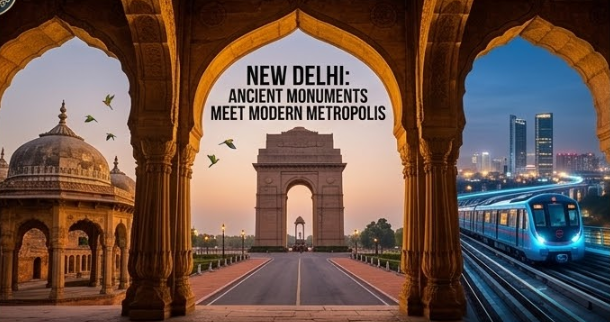
Have you ever stood at a traffic light, listening to the futuristic hum of electric cars and the sleek whoosh of an air-conditioned metro train passing overhead, only to turn your head and see a towering, 500-year-old stone tomb resting quietly in a manicured garden?
If you haven’t, then you haven’t been to Delhi.
When we talk about New Delhi: Ancient monuments meeting modern metropolis, we are not just throwing around a catchy travel slogan. We are describing the everyday reality of over 30 million people. India’s capital is a city afflicted with a beautiful case of split personality. It is a place where time does not move in a straight line; it loops, overlaps, and folds in on itself.
In this ultimate guide, we are going to take you on a journey through the heart of India. We will walk through the dusty, spice-scented lanes of ancient empires, ride the ultra-modern public transit systems, and explore exactly how New Delhi flawlessly balances its heavy historical crown with its ambitions of being a 21st-century global superpower.
1. The Soul of the City: A Tale of Eight Cities
To understand the modern metropolis, you first have to understand the ghosts that live beneath its concrete. Delhi is not just one city; it is a graveyard of empires. Historians often say that Delhi has been built, destroyed, and rebuilt at least seven times (some argue eight) over the last three millennia.
From the mythical city of Indraprastha mentioned in the ancient Indian epic, the Mahabharata, to the fortified walls of Lal Kot in the 11th century, and the grand Mughal capital of Shahjahanabad in the 17th century, every ruler who conquered northern India wanted to leave their mark on this specific patch of land along the Yamuna River.
Today, New Delhi is the eighth iteration—built by the British in the early 20th century. But the beautiful thing is that the previous seven cities didn’t just disappear. Their ruins are scattered everywhere, integrated into the modern landscape. You will find ancient stepwells hiding between glass skyscrapers and medieval watchtowers sitting in the middle of modern golf courses.
2. Stepping Back in Time: The Ancient and Medieval Masterpieces
If you are a history buff, New Delhi is an open-air museum. Let’s look at the cornerstone monuments that anchor the city to its ancient past.
Qutub Minar: The Tower of Victory
Located in South Delhi, the Qutub Minar is a soaring, 73-meter-high tower of victory, built in 1193 by Qutab-ud-din Aibak immediately after the defeat of Delhi’s last Hindu kingdom. Made of red sandstone and marble, its walls are intricately carved with verses from the Quran.
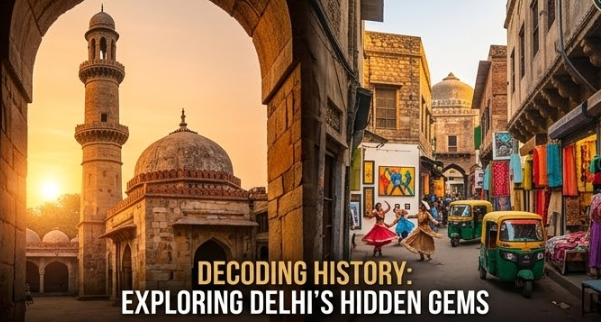
- The Human Touch: When you stand at the base of this tower and look up, it induces genuine vertigo. But the most fascinating part isn’t the tower itself; it’s the Iron Pillar standing in the courtyard. Cast in the 4th century, this pillar has been exposed to the harsh Delhi weather for over 1,600 years, yet it has never rusted. Ancient Indian metallurgy was centuries ahead of its time, and science still marvels at it today.
Humayun’s Tomb: The Blueprint for the Taj Mahal
Before the Taj Mahal became the global symbol of love, there was Humayun’s Tomb. Built in 1570, it was the first garden-tomb on the Indian subcontinent. Commissioned by the Mughal Emperor Humayun’s first wife, Bega Begum, it is a masterpiece of red sandstone and brilliant white marble.
- The Human Touch: The best time to visit Humayun’s Tomb is just before sunset. The golden hour light hits the red sandstone, making it glow against the darkening sky. Parrots fly between the ancient domes, and for a moment, the chaotic traffic noise of the modern city outside the gates completely fades away.
The Red Fort (Lal Qila): The Heart of the Mughal Empire
When Emperor Shah Jahan (the creator of the Taj Mahal) decided to move his capital from Agra to Delhi in 1638, he built the magnificent Red Fort. For nearly 200 years, this massive complex of red sandstone walls, audience halls, and marble palaces was the absolute center of power in India.
- The Human Touch: Today, the Red Fort stands directly across the street from one of the busiest, most chaotic markets in the world (Chandni Chowk). Standing at the majestic Lahore Gate, you can literally see the physical line where the ancient monuments meet the hyper-active modern local economy.
Safdarjung Tomb and Lodi Gardens: Where History Breathes
Lodi Gardens is the perfect encapsulation of New Delhi: Ancient monuments meeting modern metropolis. Spread over 90 acres, this lush public park contains the architectural works of the 15th-century Lodi dynasty.
- The Human Touch: On any given Sunday morning, you will see a beautifully bizarre sight here. Modern Delhiites—wearing Apple Watches, Lululemon yoga pants, and AirPods—jogging, doing Zumba, or walking their Golden Retrievers right next to 500-year-old domed mausoleums. History isn’t cordoned off behind glass in Delhi; it is part of the morning routine.
3. The Colonial Transition: Lutyens’ Delhi
As we move forward in time, the architecture shifts from Mughal domes to grand European columns. In 1911, the British decided to shift the capital of India from Calcutta to Delhi. They brought in architects Sir Edwin Lutyens and Sir Herbert Baker to design a sprawling, modern administrative center.
India Gate
Standing at 42 meters tall, India Gate looks remarkably like the Arc de Triomphe in Paris. It is a war memorial dedicated to the 70,000 soldiers of the British Indian Army who died in the First World War.
- The Vibe: At night, India Gate is illuminated, and the surrounding lawns turn into a massive public picnic spot. Ice cream vendors, balloon sellers, and families gather here, turning a solemn memorial into a celebration of modern, free Indian life.
Rashtrapati Bhavan (The President’s Estate)
At the opposite end of the Rajpath (now called Kartavya Path) sits the Rashtrapati Bhavan, the official residence of the President of India. With 340 rooms and a massive dome, it is one of the largest residences of any head of state in the world. It perfectly blends classical European architecture with Indian motifs like stone chhatris (umbrellas) and elephant statues.
4. The Modern Metropolis: Fast-Paced New Delhi
Now, let’s step out of the past and into the blinding speed of the present. New Delhi is the political, commercial, and cultural capital of the fastest-growing major economy on Earth. It is a city that never stops building, moving, and evolving.
The Delhi Metro: The Lifeline of the City
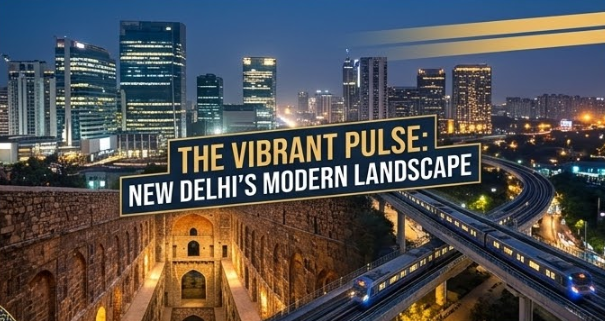
You cannot talk about modern Delhi without talking about its Metro system. Spanning nearly 400 kilometers with over 280 stations, it is one of the largest and most advanced rapid transit systems in the world.
- The Contrast: The Delhi Metro is air-conditioned, spotlessly clean, and operates with extreme punctuality. You can step out of the blazing heat and chaotic traffic of a 17th-century medieval bazaar, walk down a flight of stairs, and instantly be transported into a sleek, cool, futuristic environment. It is the ultimate time machine connecting the old and the new.
Connaught Place (CP): The Commercial Hub
Designed as a massive circle with grand white colonnaded buildings, Connaught Place was originally the elite shopping district for the British. Today, it is the beating heart of modern Delhi’s retail and corporate world. Here, you will find high-end international brands, vintage cinemas, trendy microbreweries, and modern co-working spaces.
- Underground Secrets: Right beneath this colonial-era structure lies Palika Bazaar, an underground, fully air-conditioned market that sells modern electronics, video games, and clothes, showcasing how Delhi optimizes its space.
Cyber Hub and the NCR Outskirts
To truly see the “modern metropolis,” you only need to take a 30-minute drive south to Gurugram (part of the National Capital Region, or NCR). Here, the ancient ruins vanish, replaced by a glittering skyline of steel and glass. This is the corporate headquarters for Fortune 500 companies in India. The Cyber Hub area is a futuristic dining and entertainment complex that feels more like Singapore or Dubai than traditional India.
Contemporary Architectural Marvels
Modern Delhi doesn’t just build glass boxes; it continues to create monumental architecture.
- The Lotus Temple: Built in 1986, this Bahá’í House of Worship is shaped like a giant, unfolding white marble lotus flower. It is a spectacular piece of expressionist architecture that attracts millions of visitors seeking a quiet place for meditation.
- Akshardham Temple: Opened in 2005, Akshardham looks like it has been there for a thousand years. It is a colossal, intricately carved Hindu temple complex built using traditional techniques (without steel), yet it houses modern animatronic shows, IMAX theaters, and a musical fountain.
5. The Ultimate Collision: Hauz Khas Village
If you want to experience the exact physical point where New Delhi: Ancient monuments meeting modern metropolis reaches its peak, you must visit Hauz Khas Village (HKV).
In the 13th century, Hauz Khas was a large water reservoir built by Allauddin Khilji to supply water to his new city. Surrounding it are the ruins of a madrasa (Islamic seminary), a mosque, and several tombs built in the 14th century.
Fast forward to the 21st century. Today, the narrow lanes leading up to these ancient stone ruins are packed with the trendiest boutiques, underground techno clubs, high-end art galleries, and artisanal coffee roasters.
The Experience: You can sit on the rooftop of a modern European-style cafe, sipping a perfectly brewed iced latte, while looking directly out over a 700-year-old stone dome and a tranquil lake. The juxtaposition is jarring, beautiful, and uniquely Delhi. Young musicians play indie rock inside pubs, while outside, the stone walls whisper tales of medieval scholars.
6. The Culinary Canvas: Eating Through Time
A city’s culture is best understood through its food, and Delhi is the undisputed food capital of India. The culinary scene perfectly mirrors the city’s architectural split personality.
The Ancient Flavors: Old Delhi Street Food
To taste history, you must go to Chandni Chowk in Old Delhi. Here, culinary traditions have been passed down through generations for centuries.
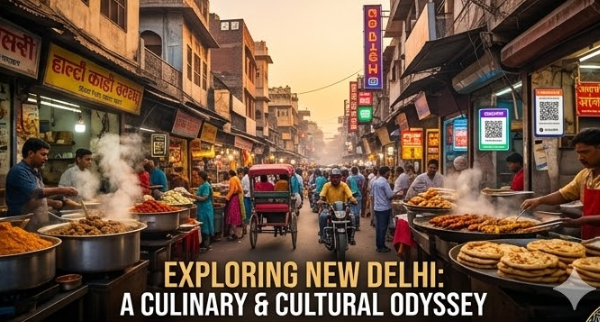
- Paranthe Wali Gali: A narrow lane famous for deep-fried stuffed bread (paranthas). Some shops here have been serving food since the 1870s!
- Karim’s: Located near the Jama Masjid, this legendary eatery was supposedly started by the descendants of the royal chefs of the Mughal Empire. Their slow-cooked mutton korma and kebabs offer a literal taste of the 16th century.
The Modern Palate: Fine Dining and Global Cuisine
Contrast this with the modern metropolis. Delhi boasts some of the world’s best fine-dining restaurants, heavily featured on the “Asia’s 50 Best Restaurants” lists.
- Indian Accent: Located in the sleek Lodhi Hotel, this restaurant takes traditional Indian flavors and applies modern, molecular gastronomy techniques to them. It is Indian food reimagined for the 21st-century global traveler.
- From authentic Japanese sushi bars in Chanakyapuri (the diplomatic enclave) to vibrant Italian pizzerias in Meherchand Market, modern Delhi is a global melting pot of flavors.
7. Practical Travel Tips for the Modern Explorer
If you are planning to witness this beautiful collision of eras for yourself, here are some practical, human-to-human tips to help you survive and thrive in New Delhi.
1. The Best Time to Visit
Delhi is a city of extremes. The summers (May to July) are blisteringly hot, with temperatures soaring to 45°C (113°F). The monsoons (August to September) are incredibly humid. The Sweet Spot: The best time to visit is from October to March. The weather is cool, sunny, and perfect for spending hours walking around ancient forts. Just pack a good jacket if you visit in January, as the nights get surprisingly cold!
2. Getting Around
Do not try to drive in Delhi unless you grew up here; the traffic has a rhythm that outsiders rarely understand.
- Use the Metro: It is cheap, safe, incredibly fast, and connects almost every single tourist monument and modern mall.
- Ride-Hailing Apps: Download Uber or Ola. They are reliable and eliminate the need to haggle over fares with taxi drivers.
- Auto Rickshaws: For short distances, taking a green-and-yellow three-wheeler (tuk-tuk) is a must-do experience. Just be sure to negotiate the fare before you get in!
3. Dress Codes and Respect
While modern Delhi (malls, pubs, Connaught Place) is very cosmopolitan and you can wear whatever you like, the ancient monuments often include active religious sites.
- When visiting the Jama Masjid, Gurudwara Bangla Sahib, or any temple, you must dress modestly. Both men and women should cover their shoulders and knees. You will also be required to take off your shoes at religious sites, so wear slip-ons!
4. Embrace the Chaos
The most important tip for visiting Delhi is to adjust your mindset. It is going to be loud. It is going to be crowded. Your senses will be overwhelmed. Don’t fight it. Embrace the chaos. Let the energy of 30 million people wash over you.
Conclusion: The Magic of the Delhi Time Machine
There are very few places on the planet where history isn’t something you just read about in a book—it is something you physically navigate around on your commute to work.
New Delhi: Ancient monuments meeting modern metropolis is a concept that defies logic. By all accounts, the aggressive modernization, the booming tech sectors, and the massive population growth should have bulldozed the past. But Delhi stubbornly refuses to let go of its history.
It is a city where a teenager in a Metallica t-shirt will buy a modern smartphone from a high-tech mall, and then stop to light an incense stick at a 14th-century Sufi shrine on his way home.
Delhi doesn’t ask you to choose between the old and the new. It offers you both, side by side, on the very same street. It is frustrating, beautiful, poetic, and absolutely unforgettable. Pack your bags, bring an open mind, and get ready to step into the world’s most vibrant time machine.