On the afternoon of April 14, 1944, two consecutive explosions rocked the island city of Mumbai, causing massive fireballs that engulfed the shipyard and adjacent neighborhoods. Infamously known as the Bombay Dock blasts, the incident remains one of the largest fire disasters in the city’s history.
The explosions were caused by a British cargo ship, the SS Fort Stikine, which was transporting ammunition for the ongoing World War II. The ship caught fire in the afternoon, and within hours, massive explosions split the mammoth-sized ship in two. The impact was so intense that it was recorded by seismographs.
Firefighting operations continued for three days, with the then Bombay Fire Brigade rescuing workers and civilians trapped inside warehouses within the port compound. A central element of these rescue efforts was a vehicle-mounted rotating ladder (TTL) made of cast iron.
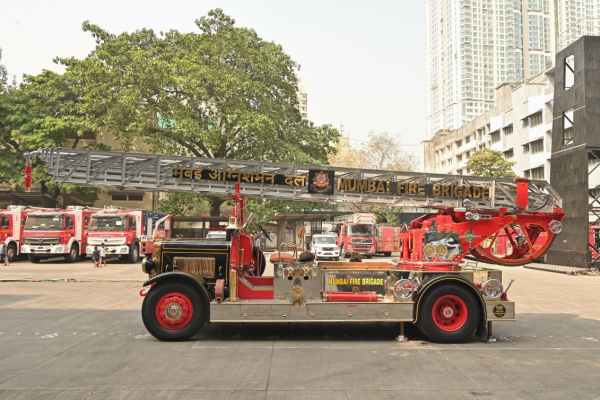 According to officials, the vehicle’s iron body and sleek design made it easier to maneuver through the shipyard’s congested streets. (Express Photo)
A turntable ladder is a small truck equipped with a ladder mounted on a hydraulic platform that can be raised and rotated during rescue operations. During the fire of 1944, the ladder was raised to help trapped workers get down from the warehouses to safer places.
More than eight decades later, the Mumbai Fire Brigade (MFB) restored the ladder-mounted rescue vehicle, returning it to motor condition. The restored vehicle will be inaugurated by Chief Minister Devendra Fadnavis on the morning of Republic Day.
“This vehicle is a testimony to the valor of MFB. The loss of life in the 1944 fire would have been much higher if the brigade had not immediately intervened in the rescue operation. This machine played a vital role as with the help of this vehicle we were able to rescue more than 100 workers who were trapped inside the compound,” an official said.
According to officials, the vehicle’s iron body and sleek design made it easier to maneuver through the shipyard’s congested streets. It was also equipped with a bell to alert people to make way during rescue operations.
Story continues below this ad.
Firefighters’ records show that the vehicle was manufactured in 1937 by the British automobile company Leyland and was incorporated into the brigade in 1941.
“During the 20th century, ladders like these were labeled in the category of sophisticated equipment, as most of the country’s firefighting agencies could not afford to add high-end vehicles to their fleets,” the official said.
After decades of use, the vehicle was finally decommissioned and kept as a souvenir at the MFB headquarters in Byculla. Civic officials said a decision was taken last year to renovate and restore it.
As part of the restoration, spare parts were exchanged and the vehicle was repainted in its original red color. The hydraulic levers have been greased and oiled to ensure smooth operation, while the engine and chassis have been completely refurbished. New tires were also installed to make the vehicle roadworthy.
Story continues below this ad.
However, officials clarified that the vehicle will not be used for firefighting operations. Instead, it will be displayed at fire department headquarters and maintained periodically. On special occasions like Firefighters Week, Republic Day and Independence Day, it will be taken out for parades.
“The restoration drive was a Herculean task as many of the spare parts that were used to build this vehicle back then are not available today. Therefore, we had to go through old vehicle records and customize alternative parts to ensure they fit the vehicle,” the official said.
The explosions at the Bombay dock
In February 1944, at the height of World War II, the British freighter SS Fort Stikine set sail from England as part of a 20-ship naval convoy bound for Asian waters. The convoy was to transport ammunition and supplies for attacks against Japanese forces.
In addition to explosives and ammunition, the ship was carrying gold bars and a mini fighter plane. En route to Mumbai (then Bombay), it stopped at the port of Karachi, where large quantities of flammable materials such as cotton, oil, scrap metal and sulfur were loaded onto the ship.
Story continues below this ad.
On the morning of 14 April, while docked at Victoria Dock and waiting to be unloaded, a fire broke out on the ship’s deck. Attempts to extinguish the fire failed as it rapidly intensified due to the presence of flammable cargo. Within hours, two explosions shook the docks.
Firefighter records indicate that the first explosion occurred at 4:06 p.m., followed by a second at 4:41 p.m.
It took three days to control the fire. More than 8,000 people worked day and night for seven months to remove nearly five lakh tonnes of debris. The official death toll was 740, including 476 military personnel. Up to 1,800 people were injured and 27 ships and boats were sunk.
To commemorate the tragedy, the week beginning April 14 is celebrated nationally as Fire Safety Week.