
“Jai Baba Kedar!”
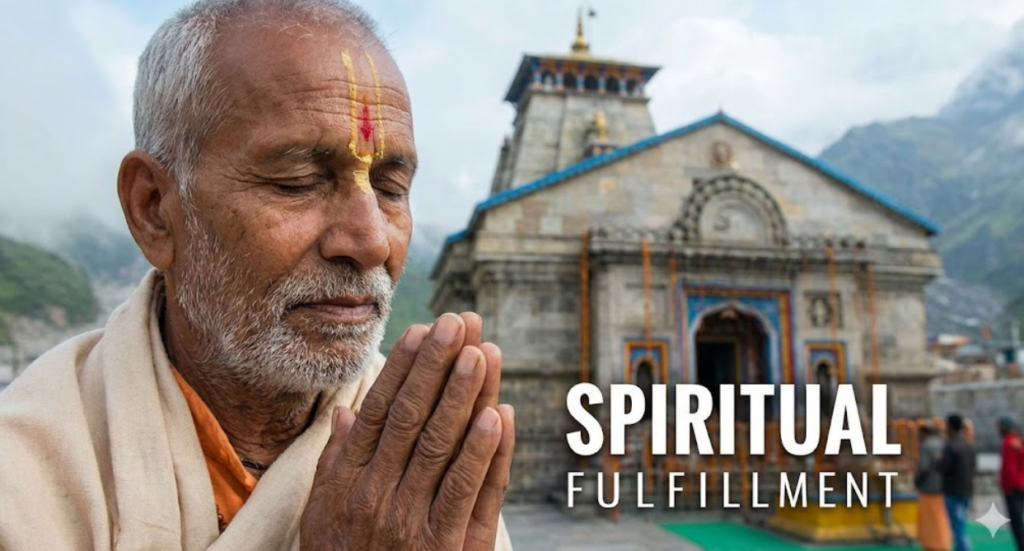
For millions of devotees, Kedarnath is not just a destination; it is an emotion. Nestled in the lap of the majestic Garhwal Himalayas in Uttarakhand, the Kedarnath Temple stands as a beacon of faith, resilience, and divine energy. As one of the twelve Jyotirlinga of Lord Shiva and a crucial part of the Chota Char Dham Yatra, visiting this holy site is a dream for many.
The silence of the mountains, the roar of the Mandakini river, and the rugged terrain test not just your physical strength but your spiritual resolve. If you are planning to undertake the Kedarnath Yatra in 2026, you likely have hundreds of questions. When will the temple open? How do I book a helicopter? Is the trek difficult?
This comprehensive guide covers everything you need to know about the Kedarnath Yatra 2026 Opening Date, registration, weather, route, and travel tips to make your journey safe and spiritual.
1. The Divine Call: Why Visit Kedarnath?
Before we dive into the logistics, let’s understand the significance. Kedarnath Mandir is located at an impressive Kedarnath height of 3,583 meters (11,755 feet).
The Legend of the Pandavas
The history of this temple dates back to the era of the Mahabharata. Legend says that after the Great War, the Pandavas felt guilty for killing their own kin (the Kauravas). To seek redemption, they sought Lord Shiva’s blessings. However, Shiva was annoyed with them and wanted to avoid granting them audience.
He fled to Kedarnath and took the form of a bull. When Bhima (the strongest Pandava) recognized him and tried to catch the bull by its tail and hind legs, the bull dove into the ground. The hump of the bull remained on the surface, which is now worshipped as the conical Shiva Lingam inside the temple.
The energy here is palpable. Whether you have seen the beauty of the temple in a Kedarnath photo or watched the Sushant Singh Rajput starrer Kedarnath movie, nothing compares to standing in front of the stone temple with the snow-clad peaks behind it.
2. Kedarnath Opening Date 2026
The most common question pilgrims ask is: When will the temple open?
The Kedarnath Temple opening date 2026 is not fixed by a calendar date but is decided based on the Hindu Panchang by the priests of Omkareshwar Temple in Ukhimath.
- Announcement: The exact date is usually announced on the occasion of Mahashivratri (February 2026).
- Expected Date: Traditionally, the doors of Kedarnath open to the public on the auspicious day of Akshaya Tritiya. For 2026, this is likely to fall in the first or second week of May 2026.
- Closing Date: The temple closes on the day of Bhai Dooj (usually immediately after Diwali) in October or November. During winter, the deity is moved to Ukhimath, where worship continues.
Pro Tip: If you want to avoid the massive initial rush of May, plan your trip for late September or early October. The views are clearer, and the crowd is manageable.
3. How to Reach Kedarnath: The Journey Begins
Reaching Kedarnath Dham requires a mix of train, road, and foot travel. Here is how you can plan your route.
Step 1: Reaching the Base (Haridwar/Rishikesh/Dehradun)
Most yatris start their journey from Delhi.
- Delhi to Kedarnath: There is no direct flight or train. You must first reach Haridwar or Rishikesh.
- By Train: Book a ticket to Haridwar or Rishikesh railway station.
- By Air: The nearest airport is Dehradun (Jolly Grant Airport).
- By Bus: You can take a Volvo from Delhi ISBT to Haridwar.
Step 2: Road Trip to Sonprayag/Gaurikund
From Haridwar or Rishikesh, you need to travel by road to Sonprayag.
- Route: Haridwar to Kedarnath (via Devprayag, Srinagar, Rudraprayag, Guptkashi).
- Haridwar to Kedarnath distance: Approximately 240 km. It takes 10-12 hours due to winding mountain roads.
- Rishikesh to Kedarnath: Approximately 216 km.
- Dehradun to Kedarnath: You can hire a taxi directly from the airport to Sonprayag.
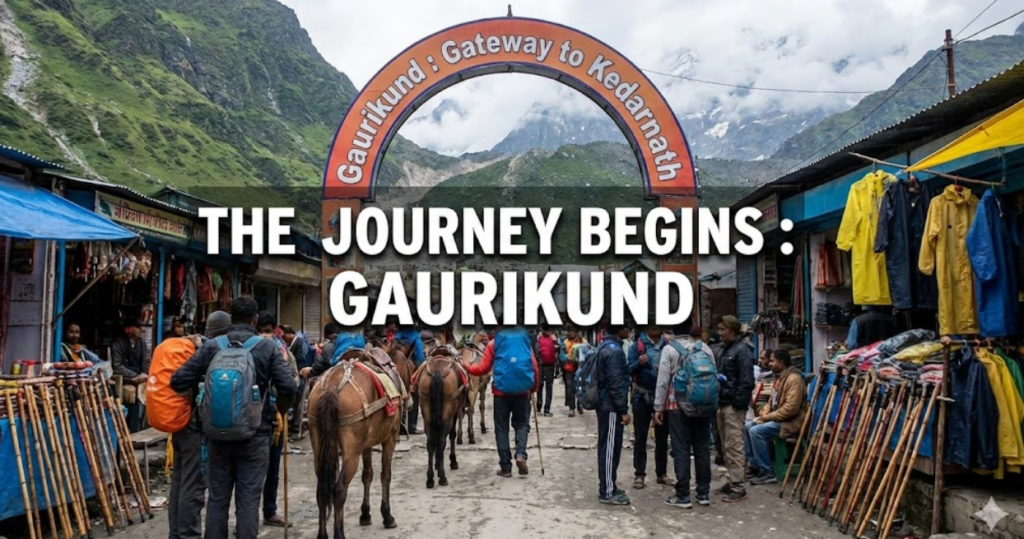
Note: Private vehicles and taxis are usually stopped at Sonprayag parking. From Sonprayag, you must take a shared local jeep (costing approx ₹50) to reach Gaurikund, which is the starting point of the trek.
4. The Kedarnath Trek: A Detailed Breakdown
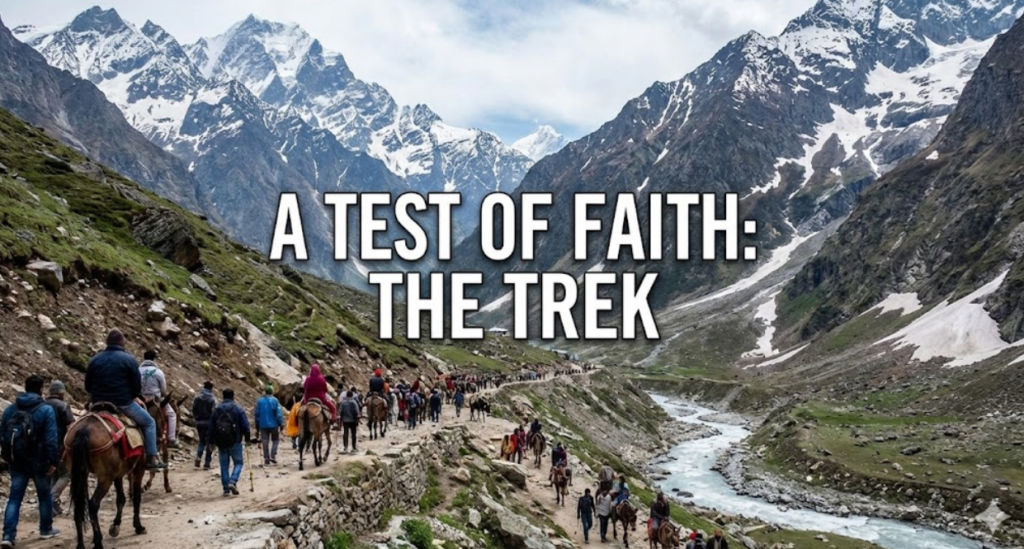
The real yatra begins at Gaurikund. This is where your endurance is tested.
- Kedarnath Distance (Trek): The trek is approximately 16 to 18 km long.
- Difficulty: Moderate to Difficult. The path is paved but steep.
- Duration: It takes a healthy person 7 to 9 hours to climb up and 4 to 6 hours to come down.
The Route Station by Station:
Understanding the route helps you pace yourself.
- Gaurikund (Start): Take a dip in the hot springs (if open) and start your trek.
- Jungle Chatti (4 km): The first major halt. You cross the bridge over the roaring Mandakini river. It’s a good place to have water.
- Bheem Bali (6 km): A midway point with accommodation and food stalls. The path is relatively moderate here.
- Linchauli (10 km): This is where the trek gets tough. The ascent becomes steep, and the air gets thinner. Take frequent breaks here.
- Base Camp (16 km): You finally see the majestic Kedarnath peak. From here, the temple is just a flat 1 km walk.
Trek Options:
- Walking: The most spiritual way. Requires good stamina.
- Pony/Mule: Available at Gaurikund. Prices are fixed by the government (approx ₹2500-₹3000 one way) but fluctuate with demand.
- Palki/Dandi: Carried by four people, suitable for the elderly or differently-abled.
- Kandi: A basket carried by a porter, suitable for small children.
Health Warning: The oxygen levels are lower at this altitude. If you have heart or respiratory issues, consult a doctor. Unlike Vaishno Devi, which is at a lower altitude, Kedarnath is physically demanding.
5. Inside the Temple Complex: What to See
Once you reach the top, the fatigue disappears. The sight of the temple is mesmerizing.
- The Temple Architecture: Built by Adi Shankaracharya in the 8th century, the temple is made of massive grey stone slabs interlocked without cement. It has survived glaciers and the 2013 floods, which is a miracle in itself.
- The Nandi Statue: Outside the temple door, a massive stone bull (Nandi) sits guarding the deity. Devotees whisper their wishes into Nandi’s ear before entering.
- Garbha Griha (Inner Sanctum): Inside, you will see the triangular (hump-shaped) Shiva Lingam.
- Adi Shankaracharya Samadhi: Just behind the temple is the resting place of Adi Shankaracharya, the saint who revived Hinduism and established the Char Dham.
6. Kedarnath Helicopter Booking 2026
For those who cannot trek or are short on time, the Kedarnath helicopter service is a blessing.
- Departure Points: Helicopters fly from Phata, Sersi, and Guptkashi.
- Kedarnath Helicopter Price: The rates are government-regulated. As of previous years, a round trip costs between ₹5,500 to ₹8,000 per person.
- Booking Process:
- Crucial: Book ONLY through the official IRCTC HeliYatra website. Do not trust private travel agents promising tickets, as helicopter scams are very common.
- Timing: Tickets for Kedarnath Yatra 2026 Helicopter Booking usually open 2-3 months in advance and sell out in minutes. You must be very fast.
- Weight Limit: Passengers over 80kg may have to pay an extra charge.
7. Mandatory Requirement: Kedarnath Registration 2026
In recent years, the Uttarakhand government has made Kedarnath yatra registration mandatory to control the crowd. You cannot proceed beyond Sonprayag without this.
How to Register:
- Online: Visit the official Uttarakhand Tourism website or download the “Tourist Care Uttarakhand” app.
- WhatsApp: There is usually a WhatsApp number provided by the tourism board for easy registration.
- Offline: Registration counters are available at Haridwar, Rishikesh, and Sonprayag, but the queues are long. It is highly recommended to do Kedarnath registration 2026 online before leaving home.
8. Weather and Best Time to Visit
The Kedarnath weather is highly unpredictable. It can be sunny one minute and raining the next.
- Summer (May – June): The best time. Kedarnath temperature ranges from 5°C to 18°C. Pleasant for trekking.
- Monsoon (July – August): High risk of landslides. The route often gets blocked. Avoid if possible.
- Autumn (September – October): The weather clears up. The views are crisp, but it starts getting very cold.
- Winter (November – April): The temple is closed due to heavy snowfall.
Always check “weather Kedarnath” on Google a day before your trek.
9. Combining Kedarnath with Badrinath (Do Dham Yatra)
Many pilgrims combine Kedarnath Badrinath into a single trip. While Kedarnath represents Shiva (the destroyer/transformer), Badrinath Temple is dedicated to Lord Vishnu (the preserver).
About Badrinath
Located on the banks of the Alaknanda river, Badrinath is easier to reach as it is connected by a motorable road (no trek required). The Badrinath temple opening date 2026 is usually a few days after Kedarnath.
- Kedarnath to Badrinath Distance: It is roughly 218 km by road.
- Route: You have to come down to Rudraprayag and then take the route towards Joshimath to reach Badrinath.
- Itinerary: Ideally, finish Kedarnath first, then travel to Badrinath.
Must-See in Badrinath:
- Tapt Kund: A natural hot water spring right below the temple. Despite the freezing cold river nearby, the water here is boiling hot. A dip here is mandatory before entering the temple.
- Mana Village: Located 3 km from Badrinath, this is the “Last Indian Village” before the Tibet border.
- Bheem Pul: A massive rock bridge believed to be placed by Bhima for Draupadi to cross the Saraswati river.
10. How to Prepare Physically for the Yatra
The Kedarnath trek is not a walk in the park. It requires fitness. Here is how to prepare 2 months in advance:
- Cardio: Start walking or jogging 4-5 km daily. This builds stamina.
- Breathing Exercises: Practice Pranayama (Anulom Vilom and Kapalbhati). This expands your lung capacity, which helps in the thin air at high altitude.
- Stairs: Stop using the elevator. Climb stairs daily to strengthen your knees and calves.
11. Sample Kedarnath Trip Itinerary (6 Days)
Here is a detailed Kedarnath package plan you can do yourself:
- Day 1: Delhi to Haridwar/Rishikesh. Attend the Ganga Aarti in the evening. Stay overnight.
- Day 2: Rishikesh to Kedarnath (drive to Sonprayag/Guptkashi). This is a long drive (8-10 hours). Rest well.
- Day 3: Early morning taxi to Gaurikund. Start the trek at 4:00 AM. Reach Kedarnath by 2:00 PM. Evening Aarti. Stay near the temple.
- Day 4: Morning Darshan (Abhishek Puja). Trek down to Gaurikund. Drive back to Guptkashi/Rudraprayag.
- Day 5: Travel from Rudraprayag to Badrinath (if doing Do Dham) OR drive back towards Rishikesh.
- Day 6: Drive back to Haridwar and catch a train/bus to Delhi.
12. Essential Packing List
To handle the Kedarnath temperature and terrain, pack wisely:
- Warm Clothes: Thermals, down jacket, gloves, and woolen socks (even in summer). The nights are freezing.
- Raincoat: Essential. Rain is frequent in the afternoon.
- Footwear: Sturdy trekking shoes with good grip. Do not wear slippers or new shoes that might bite.
- Medical Kit: Paracetamol, painkillers, Moov/Volini spray, and Camphor (Kapoor). Smelling camphor helps if you feel breathless due to low oxygen.
- Power Bank: Electricity is scarce at the top.
- Cash: Online payments often fail due to poor network. Keep enough cash for mules and food.
- BSNL Sim Card: Jio and Airtel work intermittently, but BSNL often has the best coverage in the upper Himalayas.
13. FAQ: Frequently Asked Questions
Q: Kedarnath kahan hai? (Where is Kedarnath?) A: It is located in the Rudraprayag district of Uttarakhand, India.
Q: Is Kedarnath harder than Amarnath? A: Amarnath involves a longer trek and higher altitude, but the path to Kedarnath is steeper. Both require good fitness.
Q: What is the haridwar to kedarnath distance? A: It is about 240 km by road to Sonprayag, followed by a 16 km trek.
Q: Can I go to Kedarnath without registration? A: No. Kedarnath yatra registration is strictly checked at multiple checkpoints like Sonprayag. You will be sent back if you don’t have it.
Q: Is there a flight from Delhi to Kedarnath? A: No direct flight. You fly to Dehradun (Jolly Grant) and then take a helicopter or taxi.
Q: What is the price of a doli (palki)? A: It ranges from ₹8,000 to ₹10,000 for a round trip, depending on the weight of the person.
Conclusion: A Journey of the Soul
The Kedarnath trip is not a vacation; it is a transformation. The moment you reach the top and hear the bells ringing amidst the mountains, all your fatigue vanishes. Whether you walk, fly, or ride a pony, the destination remains the same—the feet of Lord Shiva.
Standing at the Kedarnath Dham, with the icy wind hitting your face and the chant of “Har Har Mahadev” echoing around you, you realize why people endure so much to get here. It is a place where the earth meets the sky, and the human soul meets the divine.
As you plan your Kedarnath 2026 journey, remember to respect nature. Do not litter, follow the rules, and help fellow yatris. The mountains are sacred, and keeping them clean is our duty.
Prepare well, book your Kedarnath helicopter or hotels early, and get ready for the most memorable journey of your life.
Om Namah Shivaya!