

Planning your spiritual pilgrimage to the Himalayas requires knowing the Kedarnath opening date 2026 and the intricate registration process.
Embarking on a journey to the high Himalayas is far more than a simple vacation; it is a profound spiritual undertaking that has drawn sages, seekers, and devotees to its rugged peaks for millennia. Among the most revered of these sacred destinations is the Kedarnath Temple, an ancient stone marvel dedicated to Lord Shiva, nestled at an altitude of 11,755 feet amidst the snow-clad peaks of the Garhwal range. As the air thins and the majestic Mandakini River roars in the valley below, pilgrims often describe a sense of divine peace that transcends the physical exhaustion of the journey.


For the 2026 Yatra season, the experience is set to be more organized and accessible than ever before. Recognizing the record-breaking influx of devotees in recent years, the Uttarakhand government and the Shri Badrinath-Kedarnath Temple Committee (BKTC) have introduced several groundbreaking measures. These initiatives are designed to enhance pilgrim safety, streamline the Chardham registration 2026 process, and ensure that the fragile Himalayan ecosystem is protected for future generations. From the implementation of high-tech digital health tracking to the expansion of the Kedarnath helicopter booking infrastructure, every touchpoint of the pilgrimage has been modernized.
Whether you are preparing to test your endurance on the iconic 16 km trek from Gaurikund—walking in the footsteps of Adi Shankaracharya—or planning a swift aerial arrival via the IRCTC HeliYatra service, preparation is your most valuable asset. The Himalayas are as unpredictable as they are beautiful, with weather patterns that can shift from blistering sun to freezing rain in a matter of minutes.
1. Opening and Closing Dates: The 2026 Timeline
The opening of the Himalayan shrines is a high-profile event, with dates traditionally announced on Maha Shivratri. For 2026, the portals will open in late April, aligning with the auspicious Akshaya Tritiya.
Official Opening Dates 2026
- Kedarnath Temple: April 22, 2026 (Kapat opens at 8:00 AM).
- Badrinath Temple: April 23, 2026 (Kapat opens at 6:15 AM).
- Gangotri & Yamunotri: April 19, 2026 (Coinciding with Akshaya Tritiya).
- Tungnath Temple: May 2, 2026 (The highest Shiva temple in the world).
Tentative Closing Dates 2026
The shrines close during the winter due to heavy snowfall.
- Kedarnath: November 11, 2026 (on Bhai Dooj).
- Badrinath: November 13, 2026.
- Yamunotri: November 11, 2026.
2. Mandatory Registration: Step-by-Step Guide
For 2026, Char Dham Yatra registration is non-negotiable. The government uses a GPS-based system to monitor pilgrim flow and ensure safety.
Online Registration (Started March 6, 2026)


- Portal: Visit registrationandtouristcare.uk.gov.in.
- Account Creation: Register as an ‘Individual’ or ‘Family’. You will receive an OTP on your mobile.
- Plan Tour: Select “Add New Tour.” Choose your dates for each Dham (e.g., Kedarnath temple opening date 2026).
- Add Pilgrims: Enter names, ages, and Aadhaar numbers. Upload a clear photo and a scan of your ID (10KB–150KB).
- Download Yatra Pass: Once finished, download the PDF with the QR Code. This is your “Yatra Permit” or “Parchi.”
Alternative Registration Methods
- WhatsApp: Message “YATRA” to +91-8394833833.
- App: Download “Tourist Care Uttarakhand” from the Play/App Store.
- Offline: Physical counters open on April 17, 2026, at Haridwar (Rahi Hotel), Rishikesh (ISBT), and Sonprayag.
3. Kedarnath Helicopter Booking 2026: Rules & Pricing
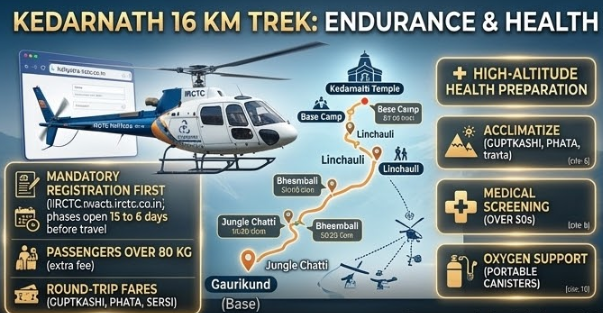
Booking a helicopter is notoriously competitive. To prevent black marketing, IRCTC HeliYatra remains the only official portal.

Booking Rules & Window
- Mandatory: You must have a Yatra Registration Number or Group ID before you can book.
- Timing: Slots open in phases, usually 15 to 6 days before your travel date.
- Limit: Maximum 2 tickets per User ID; maximum 6 passengers per ticket.
Fare List (Expected Round-Trip)
| Route | Price (Approx.) | Flight Duration |
| Phata to Kedarnath | ₹8,842 | 9 Minutes |
| Sersi to Kedarnath | ₹8,839 | 7 Minutes |
| Guptkashi to Kedarnath | ₹12,444 | 15 Minutes |
Weight Policy: Passengers over 80 kg must pay an extra fee (approx. ₹150 per kg). If you are over 100 kg, you may be required to book two seats.
4. The 16 KM Trek: Route and Landmarks
The trek starts from Gaurikund, accessible by a shared taxi from Sonprayag.
Key Waypoints on the Trek
- Jungle Chatti (4 km): First major rest stop with water and medical aids.
- Bheembali (7 km): Famous for scenic views and base-level snacks.
- Linchauli (11 km): The air begins to thin here; many pilgrims stay overnight in GMVN tents here if they start late.
- Kedarnath Base Camp (15 km): The first view of the temple spires.
- Kedarnath Temple (16 km): The final destination.
Alternative Transport on the Trek
If you cannot walk, booking is done at Sonprayag/Gaurikund counters:
- Pony/Mule: Approx. ₹4,100.
- Dandi (Palanquin): Approx. ₹4,450.
- Kandi (Small basket for children/luggage): Approx. ₹3,350.
5. The “Do Dham” Circuit: Kedarnath to Badrinath Detailed Logistics
For many pilgrims, visiting Kedarnath is only half the journey. Completing the “Do Dham” circuit by heading to Badrinath is a traditional requirement. However, this is one of the most physically demanding road journeys in India due to the mountainous terrain.
- The Route and Road Conditions: After trekking down from Kedarnath to Gaurikund and taking a taxi to Sonprayag, you begin a 218 km road journey. The route typically follows: Sonprayag → Guptkashi → Kund → Ukhimath → Chopta → Gopeshwar → Chamoli → Joshimath → Badrinath. The roads are part of the All-Weather Road Project, but they remain prone to landslides during early May rains.
- The Chopta Halt (Mini Switzerland): We highly recommend an overnight stay in Chopta. Sitting at 2,680 meters, it offers a necessary midpoint to prevent altitude sickness during the transition between the Mandakini and Alaknanda valleys. It is also the base for the Tungnath opening date 2026 trek.
- Travel Time Management: Do not plan to reach Badrinath in a single day after trekking down from Kedarnath. The descent takes 5 hours, and the drive takes another 9–10 hours. Split this into two days to ensure driver safety and pilgrim comfort.
6. Medical Preparedness & High-Altitude Health Infrastructure
The Kedarnath temperature can be deceptive; while the sun feels hot during the day, the thin air causes rapid heat loss. In 2026, the Health Department has upgraded the medical grid to handle the “High Altitude Pulmonary Edema” (HAPE) risks associated with the 3,583-meter elevation.
- Mandatory Screening: In 2026, pilgrims over the age of 50 or those with pre-existing conditions (Diabetes, Hypertension, Asthma) must undergo a Health Screening at Rishikesh or Sonprayag. If your blood oxygen (SpO2) is below 80%, you may be advised to rest for 24 hours before ascending.
- Oxygen Support Systems: “Oxygen Parlors” have been established every 2 km along the 16 km Kedarnath trek. Portable oxygen canisters (available for ₹400–₹600) are recommended for everyone, as they provide immediate relief during the final 4 km stretch from Linchauli to the temple, where the incline is sharpest.
- Emergency Evacuation: Air ambulance services are now integrated into the Kedarnath helicopter booking 2026 system. In case of severe altitude sickness, specialized medical choppers can evacuate patients to AIIMS Rishikesh within 45 minutes.
7. Sacred Landmarks: Bhim Shila, Adi Shankaracharya & Beyond
The Kedarnath temple complex is not just a single building; it is a spiritual landscape filled with secondary sites that hold immense historical and miraculous significance.
- Bhim Shila (The Miracle Stone): Positioned directly behind the main shrine, this massive rock is a must-visit. During the 2013 floods, this boulder rolled down the mountain and stopped inches from the temple, splitting the raging waters and protecting the structure. Pilgrims now offer prayers here first to thank the protector of the shrine.
- The New Adi Shankaracharya Samadhi: Following the 2021 inauguration, the Samadhi area has become a focal point for meditation. It features a 12-foot chlorite schist statue of the seer who unified the 12 Jyotirlingas. The underground design allows for a peaceful atmosphere away from the temple crowds.
- Bhairav Nath Temple (The Guardian): A steep 500-meter climb from the main temple leads to the Bhairav Nath shrine. It is locally believed that when the Kedarnath kapat closes for winter, Lord Bhairav guards the valley. Tradition dictates that your yatra is incomplete without visiting Bhairav Nath after the main darshan.


8. Packing Essentials: Technical Gear for 2026
The Himalayan environment is unforgiving. “Normal” clothes are insufficient for the Kedarnath temperature and unpredictable rain.
- The Layering System: You must use the Three-Layer Rule.
- Base Layer: Moisture-wicking thermals (avoid cotton, which stays wet).
- Middle Layer: A high-quality fleece or “Puffer” jacket for insulation.
- Outer Layer: A waterproof, windproof shell.
- Footwear Technology: Do not use flat-soled sneakers. Use trekking boots with Vibram or high-traction rubber soles. The path from Gaurikund is often wet and slippery due to mule droppings and rain; ankle support is vital to prevent sprains.
- The “Rain-Ready” Kit: In the Himalayas, it can rain even when the sun is out. Carry a heavy-duty Poncho that covers both you and your backpack. Umbrellas are dangerous on narrow trek paths and ineffective against high-altitude winds.

10. Environmental Responsibility: The “Green Yatra” 2026
With the Uttarakhand tourism numbers expected to cross 60 lakhs in 2026, the “Carry In, Carry Out” policy is being strictly enforced via digital tracking.
- The QR-Coded Plastic Policy: In a new initiative for 2026, single-use plastic bottles sold in the region carry a Digital Deposit QR Code. You pay an extra ₹10-₹20 at purchase, which is refunded only when you return the empty bottle to a designated “Digital Dustbin” in Sonprayag or Rishikesh.
- Water ATMs: To discourage plastic use, “Water ATMs” providing filtered Himalayan spring water have been installed at Jungle Chatti, Bheembali, and Linchauli. Refilling your own steel bottle is 90% cheaper than buying bottled water.
- Digital Footprint Tracking: Your Char Dham Yatra registration 2026 QR code is scanned at entry and exit. This helps the government ensure that the “Carrying Capacity” of the fragile Kedarnath valley (currently capped at roughly 15,000–18,000 pilgrims per day) is not exceeded, preventing environmental degradation.
From Gaurikund to Kedarnath: The 16 km High-Altitude Trek
The standard route to the Kedarnath Temple begins at Gaurikund, accessible by local shared taxis from Sonprayag. From Gaurikund, the 16 km trek is a rigorous test of physical endurance and mental fortitude. It ascends over 1,500 meters along a paved, but exceptionally steep path. For the 2026 Yatra season, significant upgrades have been made to the trekking infrastructure, including widened pathways, enhanced safety railings, and modernized medical aid centers positioned every 2 kilometers. While ponies and palanquins are available, a mandatory fitness check is enforced for everyone intending to walk, especially at high-altitude checkpoints. This ensures that pilgrims are prepared for the thin air and demanding terrain
Sacred Landmarks: Bhim Shila and Adi Shankaracharya Samadhi
A visit to Kedarnath is not complete without offering prayers at the sacred symbols of its miraculous survival. Positioned directly behind the main temple is the massive Bhim Shila, the enormous boulder that diverted the devastating 2013 floodwaters, leaving the 8th-century structure completely untouched. Devotees also flock to the recently rebuilt Adi Shankaracharya Samadhi, which features a stunning 12-foot statue of the sage who established the temple. This serene underground area is a powerful focal point for meditation, honoring the foundational figure of the 12 Jyotirlinga circuit.