
Cricket, particularly in its T20 avatar, is a fast-paced, ever-evolving spectacle. It’s a format where a single over can turn a game on its head, where reputation means little, and current form means everything. For fans of the shortest format of the game, one of the most common points of debate is the ICC T20 ranking.
Whether you’re a casual viewer trying to understand who is currently dominating or a die-hard fan looking for ammunition for your next cricket argument, the rankings provided by the International Cricket Council (ICC) are the closest thing we have to an objective scorecard. But what do they mean? How are they calculated? And how does a player like Sanju Samson fit into the global picture?
This comprehensive guide is your deep dive into the ICC ranking T20. We’ll cover everything from the logic behind the numbers to the specific tables for teams, batters, and bowlers, and we’ll look ahead to the ICC ranking 2026 cycle.
Part 1: Deciphering the System – How Are ICC T20 Rankings Calculated?
Before we look at the leaders, it’s crucial to understand the rules of the game. The ICC cricket ranking isn’t just a simple table of total runs or total wickets. It’s a sophisticated, automated mathematical system developed to reflect a player or team’s current form over a specific period.
The exact algorithm is complex, but the simple version is this: it’s not just what you did, but when you did it, who you did it against, and where you did it.
1. Opponent Strength
Scoring 50 runs against the number one ranked team in the world is worth significantly more points than scoring 50 against the number ten team.
2. Form and Weighting (Recency Bias)
The rankings prioritize recent performances. A blistering century two years ago is still recorded, but it carries much less weight than a solid 40 scored last week. The system employs a “decay” method, where the value of past performances slowly decreases over time.
3. Home vs. Away and Match Context
Performances away from home, particularly in difficult conditions or high-pressure matches (like an ICC World Cup), are weighted more heavily than easy runs scored at a flat-track home ground.
4. How Team Rankings Differ
For the ICC team ranking, the system looks at the aggregate performance of the team over a rolling period (usually three to four years). Wins are obviously the primary currency, but if a lower-ranked team loses a close series to the number-one ranked team, their points total might not drop significantly because they outperformed the statistical expectations of that matchup.
Part 2: The Leaders of the Pack – ICC Men’s T20 Team Rankings
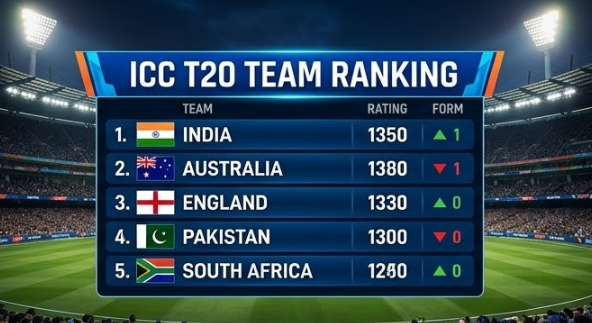
The ICC T20 men’s ranking for teams is probably the most volatile table in cricket. The margin for error in T20 is so slim that a single bad week can drop a top-tier team down a few spots, and a strong series sweep can rocket a mid-tier team upwards.
Understanding the ICC T20 team ranking is vital because it determines seeding for major events like the ICC World Cup.
As we look at the current landscape, the top-ranked teams usually include India, Australia, England, and Pakistan. These nations have the depth of talent, often honed in huge domestic leagues like the IPL (more on that later), to field incredibly strong sides.
However, the beauties of ICC T20 cricket are the upsets. Nations like Afghanistan, West Indies, and even Ireland have shown they can compete with—and beat—the best on their day. These victories significantly shake up the ICC T20 ranking team table because the lower-ranked team gains immense points for a “David vs. Goliath” victory.
Part 3: The Batter’s Battlefield – ICC T20 Batsman Ranking
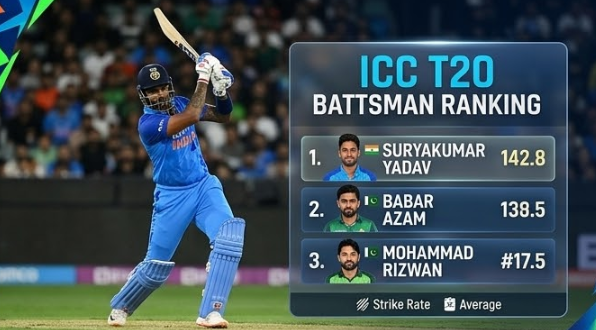
Now we get to the glamour category: the hitters. The ICC ranking batsman table for T20 is often what fans search for most. They want to know who is the most destructive and consistent force with the bat.
To succeed in the t20 batting ranking, a player needs a unique blend of two traits: Consistency and Strike Rate.
In the long history of the format, standard “anchors” (who score consistently but slowly) used to dominate. Modern ICC T20 batting ranking tables are now dominated by “impact players”—batters who can score 40 or 50 runs at an astonishing rate (150+ strike rate) that completely destroys an opponent’s bowling plans.
Analyzing the Top 10 ICC T20 Ranking Batsman
When you look at the top 10 icc t20 ranking batsman, you aren’t just looking at the players with the most runs in the last year. You are looking at the players who have performed best under pressure against good opposition recently.
Names like Suryakumar Yadav, Babar Azam, Jos Buttler, and Mohammad Rizwan are usually permanent fixtures in the icc top ranking for batters, although their exact positions constantly swap.
- Suryakumar Yadav’s rise to the top of the icc top ranking was a perfect example of the modern system. He wasn’t just scoring runs; he was scoring them 360 degrees, with an astronomical strike rate, often saving his team from difficult situations. The system rewarded this high-impact approach.
- Babar Azam and Mohammad Rizwan represent the other successful school of thought: relentless consistency. By rarely failing, they maintain a very high minimum points floor, keeping them high in the icc player ranking tables, even if their impact is sometimes less explosive.
The Problem of Selection and Ranking
A player’s rank is a “report card,” and just like at school, if you don’t show up to take the tests, you won’t get good grades. This leads us to a key point: a player who is selected irregularly (whether due to injuries or selectors’ choices) will struggle to maintain a high position in the icc t20 player ranking.
Part 4: Spotlight on the Individual – Sanju Samson’s ICC Ranking
This leads to one of the most interesting case studies in Indian cricket: Sanju Samson.
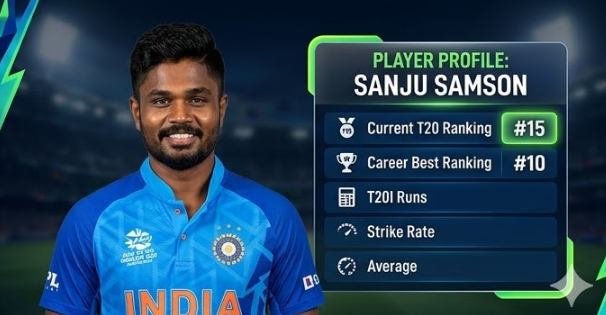
The discussion around Sanju Samson ICC ranking is a fascinating one because it highlights the gap between public perception of talent and statistical ranking. Samson is undeniably one of the most naturally gifted, popular, and explosive batters in the world, yet a casual search of the icc t20 batsman ranking might not always show him among the elite top 5.
Why is Sanju Samson not Always Ranked in the Top 10?
It all comes down to selection and consistency, the two pillars of the ranking system. To rise in the icc cricket ranking, a player needs:
- Consecutive Games: They need to be a guaranteed pick for their national side to accumulate points regularly.
- High-Profile Series: Points are won in bilateral series against other major nations or during an ICC World Cup.
For many years, Sanju Samson has been an in-and-out player for India. He has delivered moments of sheer genius, but without a long, guaranteed run of matches (a “test of consistency”), the decay function in the ranking system starts to lower his points total.
Therefore, his position in the icc player ranking often fluctuates. He might rise rapidly after a great series, only to drop slowly when the team switches to other options or when he is injured. His ranking isn’t a reflection of his potential; it’s a reflection of his recent international opportunities and conversion. For many fans, this fact only makes the conversation around his selection even more passionate.
Part 5: The Deceivers – ICC T20 Bowler Ranking
If batting is the glamour, bowling is the science. The t20 bowler ranking often receives less attention from casual fans, but it’s perhaps more important. In a format where teams now regularly target 200+ runs, a great bowler is worth their weight in gold.
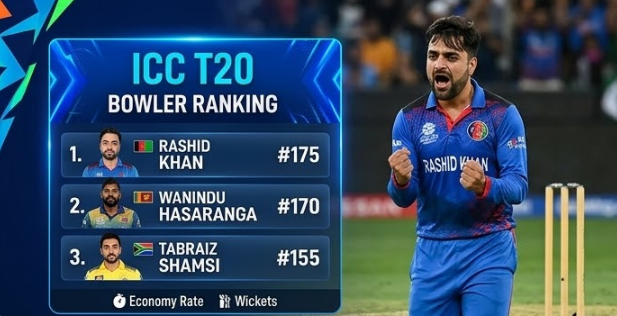
Just like the t20 batting ranking, the icc bowler ranking for T20 isn’t just about wickets. It balances two key metrics:
1. Economy Rate
This is the most crucial part of T20 bowling. A bowler who concedes 20 runs in their four overs without taking a wicket (an economy of 5.0) is often more valuable than a bowler who takes 3 wickets but concedes 50 runs (an economy of 12.5). The icc t20 bowler ranking heavily rewards economical bowling because it creates pressure that helps other bowlers at the other end.
2. Wickets (Strike Rate)
The other part is the obvious one: taking wickets. Removing a top-order batter in T20 is the ultimate act of run-prevention.
The Rise of the Leg-Spinner
If you look at the icc t20 player ranking for bowlers, you will notice it is heavily populated by leg-spinners. Names like Rashid Khan, Wanindu Hasaranga, and Tabraiz Shamsi have dominated the top spots. Why?
Leg-spinners offer the perfect combination for T20. Their natural variation and wicket-taking ability are balanced against the inherent risk of conceding runs. In modern T20, where batting pitches are flat, leg-spinners are the “X-factor” that the ranking system identifies as highly impactful.
Part 6: Understanding All-Rounders and the ‘Impact’ Player
Though your keyword list didn’t include “all-rounder ranking,” it’s impossible to have a complete picture of the icc player ranking without mentioning them.
The ICC All-Rounder ranking attempts to combine a player’s batting and bowling points. This is incredibly difficult in T20 because many players are “partial” all-rounders (a great batter who bowls the odd over, or a bowler who can smash a few 6s at the end).
A true T20 all-rounder is rare and incredibly valuable. Think of players like Shakib Al Hasan, Hardik Pandya, or Marcus Stoinis. The ranking system struggles to capture the context perfectly, but it’s a useful starting point to identify the game-changers.
This category is often where we see the concept of “impact” most clearly. An all-rounder’s rank might not be top 5 in either individual category, but they are often in the top 3 overall because of the dual threat they provide.
Part 7: The Road to ICC T20 Ranking 2026 – Looking Ahead
The rankings are not a static monument; they are a living, breathing document. The top-ranked player today could be outside the top 5 by the time the ICC T20 ranking 2026 cycle begins.
The single biggest factor that influences the rankings is the ICC World Cup. These tournaments, occurring every two years, are weighted massively. Performances during a World Cup can redefine a player’s or team’s statistical standing almost instantly.
A player who carries their team to a World Cup title will gain an enormous influx of points that can keep them at the top of the icc top ranking for months, even if they have a quiet bilateral season afterward. Conversely, a poor performance by a #1 ranked team at a World Cup can cause a catastrophic drop in their icc team ranking.
As we build toward the T20 cycle in 2026, every bilateral series, every tri-series, and especially every World Cup will be critical. This is where points decay becomes crucial. Matches from 2023 or 2024 will matter less and less, while performances in 2025 and early 2026 will become the defining metrics for the icc ranking 2026 final table.
Part 8: The Human Element – Rankings vs. Reality
As much as we love stats and the ICC cricket ranking, it’s important to remember that it is just a system. It cannot capture everything.
Rankings cannot measure:
- A Captain’s Genius: How MS Dhoni used his players or how Rohit Sharma handles pressure isn’t a stat.
- The “Moment”: A 10-run final over that defends a small total in an
ICC World Cupfinal is a legendary moment, but to the system, it’s just one over. - Leadership and Team Chemistry: These have no ranking.
- The Impact of Formats: Many of the best T20 players are also high in the icc ranking odi or test tables, showing a complete command of all formats. (But sometimes a player like Glenn Maxwell is a pure T20 match-winner, even if his icc batting ranking in tests is low.)
The “Unranked” Legends
There will always be players whom the public knows are among the best in the world, even if their icc t20 player ranking is #15. We see this with Sanju Samson, as discussed, and we see it with numerous other “X-factor” players who are match-winners but perhaps not consistent statistical accumulators.
Conclusion: The Rankings as a Starting Point
The ICC T20 ranking system is the best available tool for measuring performance in the most volatile form of the sport. It’s a sophisticated “report card” that does an excellent job of using data to create a dynamic leaderboard of form and consistency.
As a fan, the trick is knowing how to use it. Don’t look at the icc top ranking batter as “definitively better” than the #11 batter; look at them as “currently performing better against better opposition more consistently.”
The rankings are the beginning of the conversation, not the end of it. They provide the structure for our debates, the context for selection dilemmas (like the ongoing discussion surrounding Sanju Samson), and the context for understanding which teams are favorites for the next major ICC World Cup.
So the next time you check the icc men’s t20 ranking, enjoy the numbers for what they are: a statistical capture of the breathtaking form of the planet’s best cricketers in the game’s most exciting format.