
Chhatrapati Shivaji Maharaj: The Eternal King of Swarajya
“Jai Bhavani, Jai Shivaji!”
These are not just words; they are a war cry, a prayer, and a source of infinite energy for millions. When we speak of Chhatrapati Shivaji Maharaj, we are not just talking about a king who ruled a kingdom. We are talking about a visionary who ruled the hearts of his people. In a time when India was fragmented and under foreign rule, one man stood up to dream of Swarajya (Self-Rule).
Whether you are a student looking for a Shivaji Maharaj speech, an artist looking for a Shivaji drawing reference, or a devotee searching for Shivaji Maharaj HD wallpaper, this article is your ultimate journey into the life of the Great Maratha.
1. The Birth of a Legend: Early Life at Shivneri
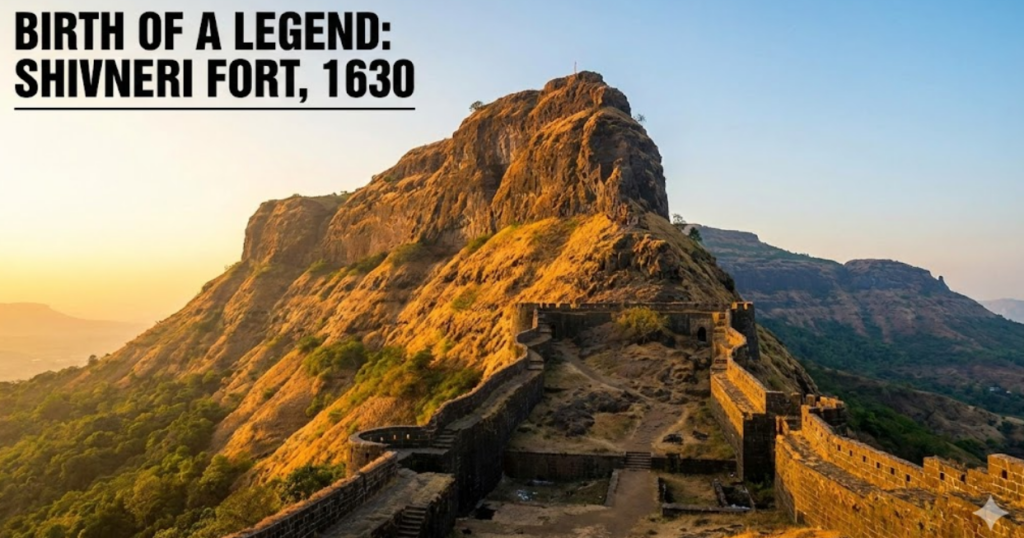
The history of India changed forever on February 19, 1630. Born on the hill fort of Shivneri, Shivaji was named after the local deity Shivai Devi. His father, Shahaji Raje, was a high-ranking general who served various Sultanates but secretly harbored a desire for independence. His mother, Jijabai, was the woman who molded him.
Jijabai did not just sing lullabies; she told him stories of the Ramayana and Mahabharata. She taught him that fighting for righteousness (Dharma) was the ultimate duty. If you look at any Shivaji Maharaj photo or painting today, you often see a calm strength in his eyes—that strength came from his mother.
Education and Training
Young Shiva ji was not trained in a palace. He roamed the Sahyadri mountains with the Mavale (local peasant soldiers). He knew every valley, every pass, and every secret trail. This knowledge of geography would later become his greatest weapon against the mighty Mughal army of Aurangzeb.
2. The Oath of Swarajya: Torna and Beyond
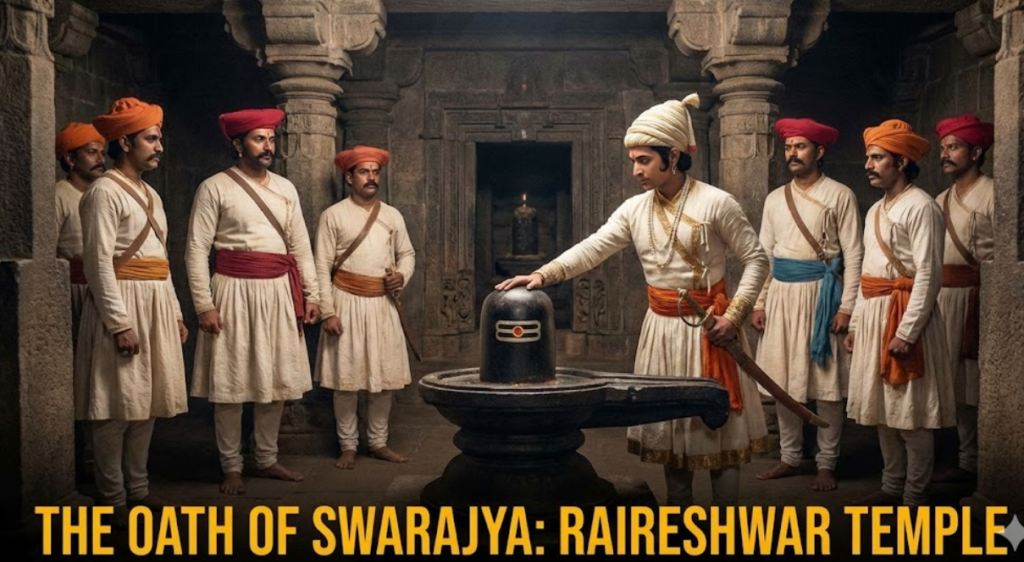
At the tender age of 16, while others were thinking of serving the Sultans, Shivaji took a bold oath at the temple of Raireshwar. He swore to establish Hindavi Swarajya—a kingdom for the people, ruled by the people.
He captured his first fort, Torna, soon after. This sent shockwaves through the Adil Shahi sultanate of Bijapur. It was the beginning of a revolution.
- Human Touch Note: Imagine a teenager today challenging a superpower. That was the level of courage Shivaji displayed. He had no treasury, no massive army—only a handful of loyal friends like Tanaji Malusare and Baji Prabhu Deshpande.
3. The Encounter with Afzal Khan: Brains Over Brawn
One of the most searched topics is Shivaji Maharaj information regarding the slaying of Afzal Khan. This event is a masterclass in strategy.
In 1659, the Bijapur Sultanate sent their giant general, Afzal Khan, to capture or kill Shivaji. Afzal Khan was a mountain of a man, known for his treachery. He invited Shivaji for a “peace meeting” at the foothills of Pratapgad.
Shivaji knew it was a trap. He wore a steel vest (chilkhil) under his clothes and hid a Wagh Nakh (tiger claw weapon) in his hand. When they hugged, Khan tried to strangle Shivaji. In a flash, Shivaji used the tiger claws to tear into Khan’s stomach.
This scene is a favorite subject for Shivaji drawing and art competitions. It teaches us that physical strength is useless without presence of mind.
4. The Rivalry with Aurangzeb and the Great Escape
The Mughal Emperor Aurangzeb dismissed Shivaji as a “mountain rat.” He would soon regret this. The rivalry between the Marathas and the Mughals is legendary.
The Raid on Shaista Khan
When Aurangzeb’s uncle, Shaista Khan, occupied Pune’s Lal Mahal (Shivaji’s childhood home), Shivaji pulled off a daring commando raid. In the dead of night, he infiltrated the palace. Shaista Khan barely escaped, losing three fingers in the process.
The Escape from Agra
However, the most cinematic moment was his escape from Agra. After being tricked and placed under house arrest by Aurangzeb, Shivaji feigned illness. He began sending out large baskets of sweets to Brahmins and the poor. On August 17, 1666, he and his son Sambhaji hid in these baskets and escaped right from under the nose of the Mughal Emperor.
This proved that Chhatrapati Shivaji could not be caged.
5. The Coronation: Becoming Chhatrapati (1674)
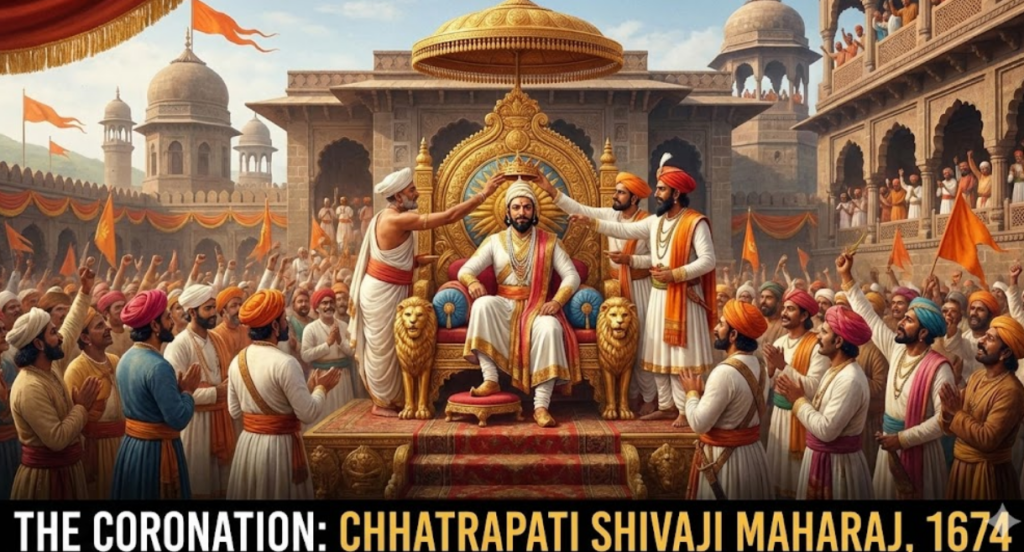
On June 6, 1674, at the majestic Raigad Fort, Shivaji was officially crowned. He became Chhatrapati Shivaji Maharaj. This was not for ego; it was a political necessity. It declared to the world that the Maratha Empire was a sovereign state, equal to the Mughals or the British.
Shivaji Jayanti is celebrated to honor his birth, but the coronation day (Shivrajyabhishek Sohala) is equally important. It gave legitimacy to the rebellion.
6. The Father of the Indian Navy
While kings like Maharana Pratap fought valiantly on land in the north, Shivaji realized something unique: “He who has the Navy, owns the sea.”
He was the first Indian ruler in the medieval era to build a powerful navy to counter the British, Portuguese, and Siddis. He built sea forts like Sindhudurg, Vijaydurg, and Khanderi.
- Fact: The Shivaji statue at Sindhudurg (which unfortunately made news recently due to weather damage) stood as a testament to his maritime vision.
- Legacy: The Indian Navy’s new ensign (flag) is inspired by Shivaji Maharaj’s royal seal (Rajmudra).
7. Sambhaji Maharaj: The Roaring Lion
You cannot talk about Shivaji without mentioning his eldest son, Sambhaji Maharaj. After Shivaji’s death in 1680, many thought the Maratha empire would crumble. But Sambhaji fought with a ferocity that stunned the Mughals.
Sambhaji faced an army of 500,000 Mughals with a much smaller force and did not lose a single fort for nine years. His sacrifice and torture at the hands of Aurangzeb is a heartbreaking but inspiring chapter that kept the fire of Swarajya burning.
8. Shivaji Jayanti 2026: A Global Celebration
As we approach Shivaji Jayanti 2026, the excitement is already building.
- Date: February 19, 2026.
- Tithi Date: Some people also celebrate according to the Hindu calendar (Falgun Vadya Tritiya).
How is it Celebrated?
- Processions: Massive rallies with Shivaji Maharaj photo frames, saffron flags, and Lezim (a folk dance).
- Shivaji Maharaj Song & DJ: The streets resonate with “Powada” (traditional ballads) and modern remixes.
- Speeches: Schools organize competitions for Shivaji Maharaj speech (Bhashan).
- Art: Kids create Shivaji Maharaj drawing and Rangolis.
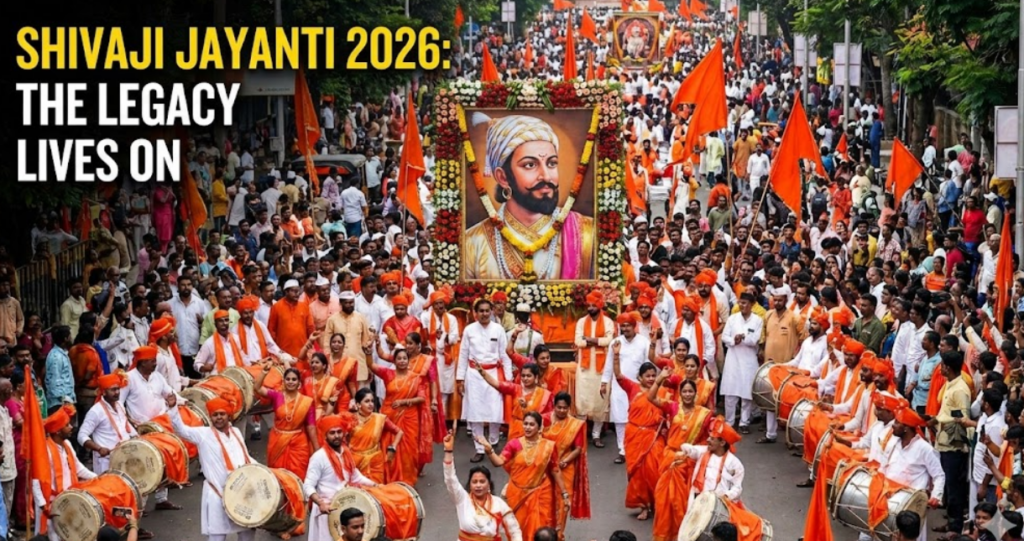
If you are planning a celebration, searching for a “Shivaji Maharaj ringtone” or “Shivaji photos” usually peaks in February.
9. Administrative Genius: Why He Was a “People’s King”
Shivaji wasn’t just a warrior; he was an administrator.
- Ryotwari System: He abolished the middlemen (Zamindars) and collected tax directly from farmers, reducing their exploitation.
- Respect for Women: In his army, if a woman from the enemy camp was captured, she was treated with motherly respect and sent back with honor. This was unheard of in medieval warfare.
- Religious Tolerance: Though a devout Hindu who fought for Hindavi Swarajya, his army had many Muslim generals (like Darya Sarang). He respected mosques and the Quran.
10. Chhatrapati Shivaji Maharaj in Pop Culture
Today, the legend lives on through media.
- Movies: Films like Tanhaji and various Marathi epics keep the history alive. Search for Shivaji Maharaj movie to find classics like Raja Shivchatrapati.
- Shivaji Maharaj HD Wallpaper: Digital artists create stunning fantasy and realistic art of the King. The most popular images usually depict him on his horse with a sword, or sitting on the throne at Raigad.
- Statues: The Shivaji statue project in the Arabian Sea is a topic of great discussion, symbolizing the scale of his impact.
11. Tips for Students: Writing a Shivaji Maharaj Speech (Bhashan)
If you are looking for Shivaji Maharaj Bhashan or Shivaji Maharaj speech for school, here is a simple structure:
- Start with a Slogan: “Jai Bhavani, Jai Shivaji!”
- Introduction: “Respected teachers and friends, today I am going to talk about a King who did not live for himself, but for his people.”
- Body: Mention 2-3 key qualities—Bravery (Afzal Khan incident), Intelligence (Agra escape), and Respect for Women.
- Conclusion: “Let us not just worship his image, but follow his path. Jai Hind, Jai Maharashtra!”
- Language: You can deliver this in English, Hindi (शिवाजी महाराज भाषण), or Marathi.
12. Keywords Analysis & Modern Relevance
Why do we see searches for Chhatrapati Shivaji Maharaj photo, Shivaji Maharaj status, and Shivaji Maharaj image? It is because people look for strength. In a world full of stress and uncertainty, looking at a Shivaji photo gives people hope. He represents the idea that a common man, with the help of common people (Mavale), can defeat mighty empires.
- Chhatrapati Shivaji Maharaj Jayanti is not just a holiday; it is a day of introspection. Are we being good citizens? Are we fearless?
13. How to Draw Shivaji Maharaj (For Artists)
For those searching for Shivaji drawing or Chhatrapati Shivaji drawing:
- Focus on the Eyes: They should be sharp and determined.
- The Beard: The characteristic pointed beard is essential.
- The Jiretop: His triangular turban (Jiretop) is iconic.
- The Chandrakor: The crescent moon on his forehead.
- Attire: Usually white or saffron Angarkha with a pearl necklace.
14. Conclusion: The King Lives On
Chhatrapati Shivaji Maharaj died in 1680, but Shiva ji the idea never died. He inspired the Peshwas, he inspired the freedom fighters against the British, and he continues to inspire modern India.
From the Shivaji Maharaj photo hd on a teenager’s phone to the Shivaji statue in Parliament, his presence is everywhere. As we look forward to Shivaji Jayanti 2026, let us remember that his greatest fort was not made of stone, but of the loyalty of his people.
He was the protector of the poor, the terror of tyrants, and the architect of modern India.
Chatrapati Shivaji Maharaj Ki Jai! Dharmaveer Sambhaji Maharaj Ki Jai!